Double-Acting Piston Hydraulic Cylinders for High-Altitude Pruning Vehicle Arm Lifting with Safety Factor Greater Than 3
Welded Construction | 42CrMo Alloy Steel | Electroless Nickel Plating | SF Greater Than 3 | Extended Rod Guide | Full Custom Engineering
High-altitude pruning vehicles are specialized machines designed to bring cutting tools and operator access to crown-level heights of 10 to 25 meters across urban boulevard tree programs, highway green corridor management, and orchard canopy maintenance operations. Their defining structural element — the pruning arm that lifts a power saw attachment or operator platform to working height — depends on a hydraulic cylinder to execute the raising, position holding, and controlled lowering functions that determine both the machine’s operational effectiveness and its crew safety profile. At these working heights, the cylinder operates in an environment that ground-level agricultural equipment cylinders are not designed to address: wind pressure on the extended arm and platform structure creates lateral forces that cycle continuously with changing wind conditions, outdoor weather exposure demands corrosion resistance beyond what indoor or covered equipment requires, and aerial work safety standards mandate structural safety factors substantially above the minimums applied to ground-level machinery. A pruning arm lifting cylinder that meets only standard agricultural equipment specifications will fail these aerial application requirements in ways that are not immediately visible in initial service — through progressive rod deflection under cumulative wind loading, through corrosion pitting under prolonged outdoor exposure, and through structural margin inadequacy that becomes apparent only when a wind gust above the design speed tests the cylinder’s actual structural limit.
The mechanical environment defining a high-altitude pruning vehicle arm lifting cylinder’s operating conditions differs from ground-level boom applications in three practically important respects. Wind loading at working heights of 15 to 25 meters creates lateral forces on the pruning arm and any attached platform that translate directly into bending moments on the cylinder rod — forces that vary continuously with wind speed and direction and that, during gusts, can instantaneously exceed the design wind pressure by factors that only a structural safety factor above 3 can accommodate safely. The corrosion exposure environment is substantially more aggressive than equivalent indoor or covered equipment: cylinder rods spend extended periods in the weather-exposed zone while the pruning arm holds a working position, accumulating rain, morning dew, urban airborne pollutants, and the high humidity characteristic of tree canopy working environments. Chinese national standard GB/T 9465 and international equivalents for mobile elevating work platforms specify minimum structural safety factors that reflect regulatory assessment of the risk level inherent in aerial work operations — requirements that the standard agricultural equipment engineering approach does not attempt to satisfy.
Our double-acting piston hydraulic cylinders for high-altitude pruning vehicle arm lifting are engineered to address all three of these aerial-specific challenges in a single integrated specification. Built from 42CrMo chromium-molybdenum alloy steel with welded construction that eliminates mechanical joint fatigue vulnerabilities, finished with electroless nickel plating that provides coating thickness uniformity and corrosion protection depth that hard chrome cannot match in unprotected outdoor conditions, and designed with structural safety factors exceeding 3 combined with extended rod guide lengths of 90 to 140 mm, these cylinders provide the structural integrity and surface durability that aerial pruning operations require rather than adapting ground-level designs to an application they were not engineered for.
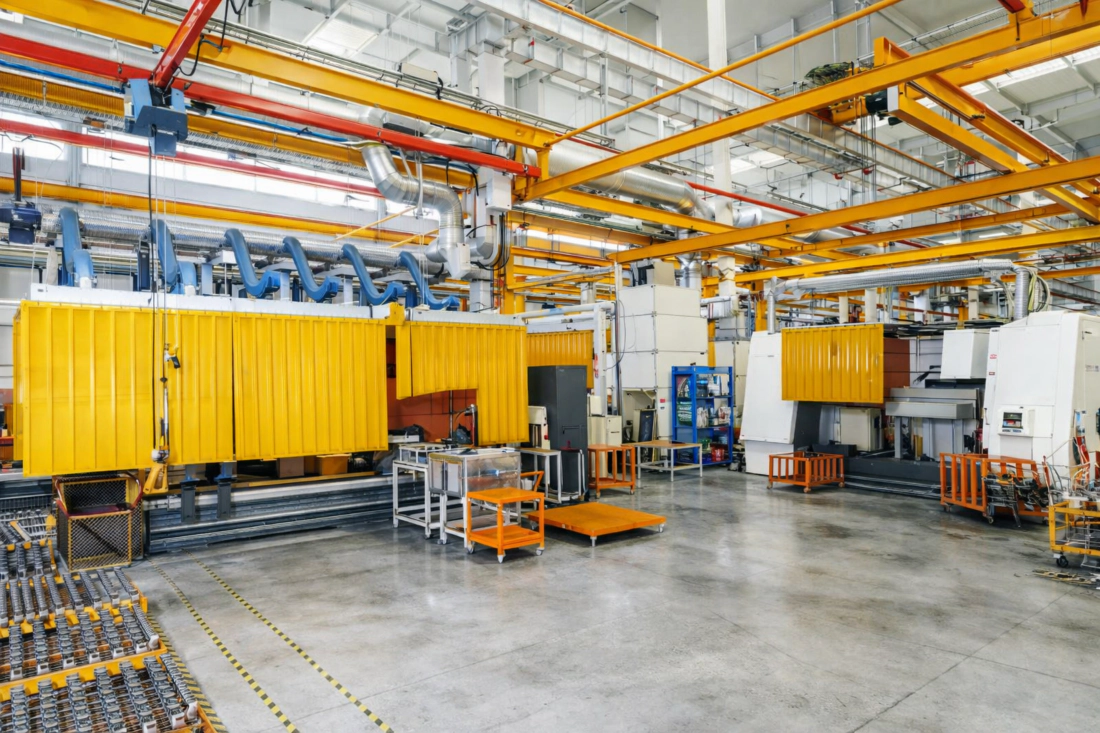
Tour Our Manufacturing Facility Virtually
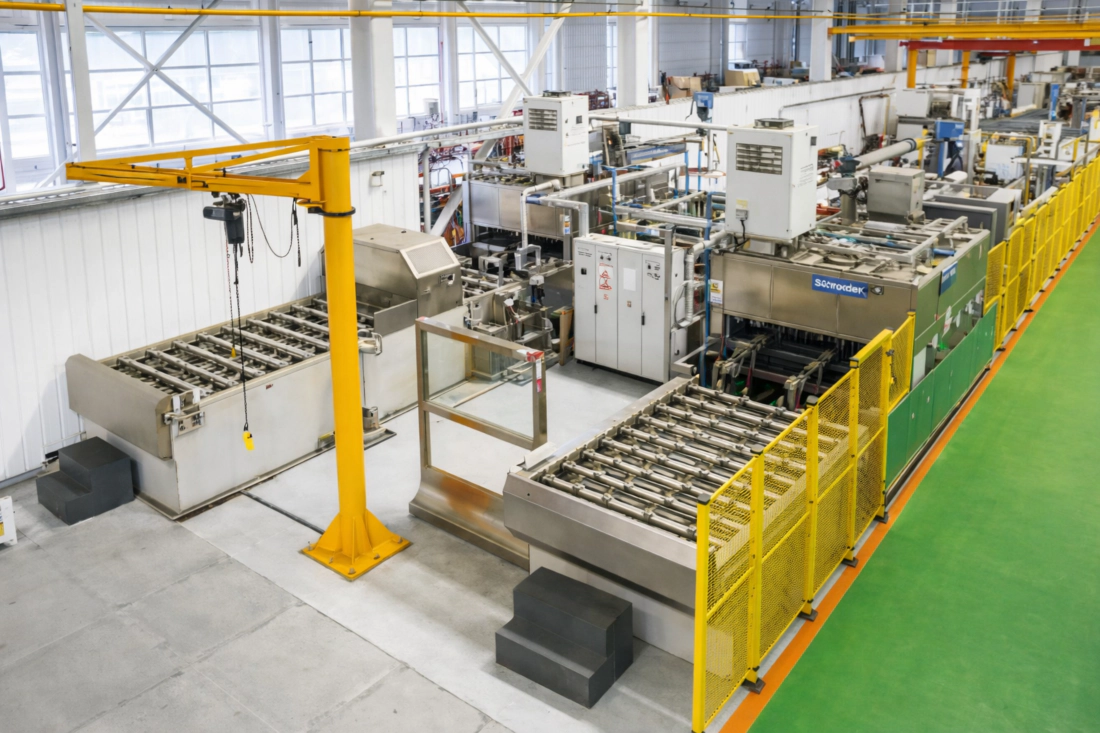
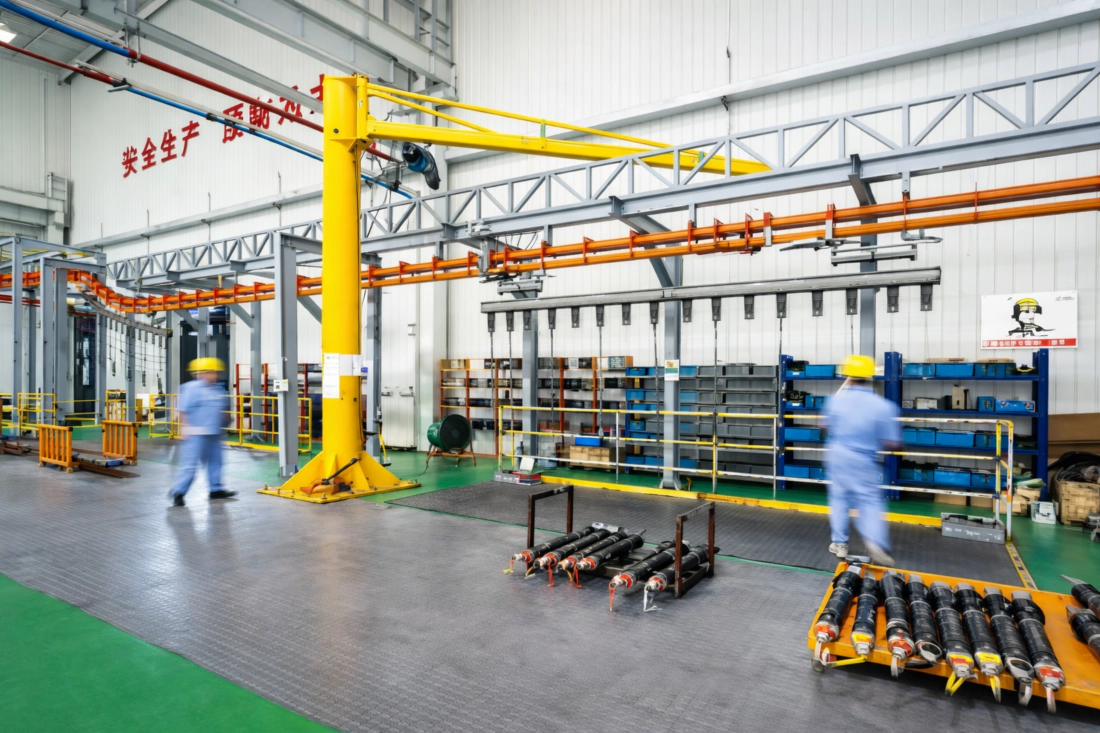
We welcome arboriculture equipment designers, municipal fleet procurement managers, and aerial work platform OEM engineers to explore our production facility from anywhere in the world. View our 42CrMo rod machining centers, electroless nickel plating lines, and structural test stations — all dedicated to engineering hydraulic cylinders that meet the demanding requirements of high-altitude aerial work applications.
Enter VR Factory Tour
Inquire Now — Submit Your Pruning Arm Specifications
How the Pruning Arm Lifting Cylinder Controls High-Altitude Operation
The double-acting piston cylinder lifting the pruning arm generates hydraulic force in both the raising and lowering directions, giving the operator or the machine’s automatic leveling system full authority over arm position against both gravitational loading and wind-induced lateral forces simultaneously. At working heights of 15 to 25 meters, wind pressure on the pruning arm structure and any attached platform or tool creates substantial lateral forces that are transmitted through the arm’s structural members to the cylinder’s mounting points. These forces vary with wind speed and direction and, in gust conditions, change rapidly in both magnitude and direction without operator input. The cylinder must maintain stable arm position against these variable lateral forces while the pruning attachment performs cutting work — a load-holding function that requires positive hydraulic authority in both extension and retraction directions, not the gravity-assisted partial control that single-acting or spring-return cylinders provide. The combination of gravitational load and wind-induced lateral force creates a combined loading condition that neither component alone would generate, and the cylinder specification must address the combined load case rather than each force in isolation.
Welded cylinder construction is the structural choice that addresses the aerial work safety requirements for this application. The safety case for hydraulic cylinders used in mobile elevating work platforms specifically identifies mechanical joint failure — including tie-rod fatigue and threaded end-cap loosening under cyclic loading — as unacceptable failure modes because they can result in uncontrolled platform lowering or structural collapse with a person at height. Our full-penetration welded construction eliminates these mechanical joint interfaces entirely, replacing them with weld joints that are individually verified by ultrasonic testing and magnetic particle inspection and collectively confirmed by pressure testing to 1.5 times rated operating pressure before assembly. The welded barrel’s structural rigidity also directly contributes to the SF greater than 3 requirement: a stiffer barrel resists the distortion under combined pressure and bending loads that would reduce the structural safety margin the calculation assumes, ensuring the engineered safety factor is maintained rather than partially eroded by real structural compliance in service.
The piston guide rings and the extended rod guide work as a two-point lateral load support system that distributes the bending moment that wind loading applies to the cylinder rod across two bearing locations separated by the cylinder body length. At the piston, bronze guide rings maintain concentricity between the piston and barrel bore under lateral loading from wind-induced forces transmitted through the boom arm structure. At the rod exit, the extended guide with its 90 to 140 mm bearing length distributes the lateral reaction force across a contact area that is two to three times larger than a standard end-cap rod carrier provides. Between these two support points, the rod behaves structurally more like a simply-supported element than a cantilever, reducing peak bending stress at the critical end-cap cross-section by an amount proportional to the extension of the guide bearing length. For an aerial pruning arm cylinder where the safety requirement mandates that the rod must not yield even under wind gusts that amplify the static design load, this stress reduction is what makes the SF greater than 3 criterion achievable within practical rod diameter constraints.
Technical Specifications — High-Altitude Pruning Arm Lifting Cylinders
The following parameters define our standard engineering range for high-altitude pruning vehicle arm lifting cylinders. All specifications are determined through application engineering review using the customer’s boom arm geometry, rated platform payload, operating height, and vehicle classification. Values listed reflect the design range appropriate for aerial pruning applications; the specific configuration for each machine is finalized from load data provided during the engineering process.
| Parameter | Specification | Engineering Notes |
|---|---|---|
| Action type | Double-acting piston | Full hydraulic authority in both lift and lower directions |
| Construction | Welded (full-penetration) | Eliminates mechanical joint failure modes required by aerial safety standards |
| Bore diameter | 70 mm to 180 mm | Standard pruning arm range: 80 to 130 mm |
| Rod diameter | 50 mm to 120 mm | Sized for SF greater than 3 under combined axial, bending, and wind load |
| Stroke range | 300 mm to 1,800 mm | Determined by pruning arm geometry and working height |
| Operating pressure | Up to 28 MPa | Test pressure: 1.5x rated, 100% of production units |
| Structural safety factor | Greater than 3 (structural yield) | Verified by calculation per GB/T 9465 and EN 280 requirements |
| Cylinder material | 42CrMo alloy steel | Tensile strength 1,000 to 1,250 MPa; yield strength 930 MPa (Q+T) |
| Rod material | 42CrMo, induction-hardened | Surface hardness HRC 54 to 60; deep case for nickel plating support |
| Rod surface treatment | Electroless nickel plating | Thickness 0.025 to 0.075 mm; uniform deposition within ±0.005 mm |
| Nickel hardness | HV 500 to 700 (as-deposited); HV 900+ (heat-treated) | Heat treatment applied based on deployment environment analysis |
| Extended guide length | 90 mm to 140 mm bearing length | Self-lubricating bronze; 2.5 to 4x standard end-cap guide length |
| Operating temperature | -25 degrees C to +80 degrees C | Extended cold-climate seals available for northern operation |
| Quality inspection | UT weld + MPI + 100% pressure test + structural calculation report | Full documentation package for aerial safety compliance records |
42CrMo Alloy Steel — Enabling Safety Factor Greater Than 3 Within Practical Dimensions
42CrMo chromium-molybdenum alloy steel is the material that makes structural safety factors above 3 achievable in high-altitude pruning arm lifting cylinders without requiring cylinder dimensions that would make the assembly too large or too heavy for the pruning arm’s linkage geometry and weight budget. Achieving SF greater than 3 means the cylinder barrel, rod, and weld joints must withstand more than three times the static design load — combined with the dynamic amplification that wind gust loading applies — before structural yielding occurs. With standard carbon steel at equivalent yield strength, meeting this safety factor would require barrel wall thicknesses and rod diameters approximately 40 to 60 percent larger than the 42CrMo equivalents, creating a cylinder that would be dimensionally incompatible with the compact pruning arm mechanisms it needs to fit and operationally problematic from a weight distribution standpoint on the elevated arm structure. 42CrMo’s yield strength of 930 MPa in quenched and tempered condition — compared to approximately 490 MPa for common S45C carbon steel — provides the structural margin needed for SF greater than 3 in dimensions that fit the physical constraints of aerial pruning arm design.
The fatigue performance of 42CrMo under cyclic loading is a material property that is at least as important as its static yield strength for high-altitude pruning vehicle applications. Wind loading does not apply as a constant static force — it varies continuously with changing wind conditions throughout every working session, applying bending cycles to the cylinder rod that alternate in direction and vary in magnitude. Over a pruning vehicle’s operational life across multiple seasons of tree maintenance programs, the cumulative fatigue cycle count reaches levels that would cause fatigue crack initiation in carbon steel rods operating at the stress levels that SF greater than 3 design allows. The Chinese national standard for aerial work platform hydraulic components recognizes this fatigue aspect by requiring safety factor calculations based on cyclic load spectra rather than simple static peak loads for equipment in the highest use-frequency categories. 42CrMo’s fatigue limit, as a fraction of its ultimate tensile strength, exceeds carbon steel equivalents by a margin that allows the rod to survive the accumulated wind-loading fatigue cycles across a full service life without crack initiation — a performance level that is not achievable in carbon steel at the same rod dimensions without violating the SF greater than 3 static requirement.
The piston rod is machined from solid 42CrMo bar stock and induction-hardened to HRC 54 to 60 at the surface before electroless nickel plating is applied. The hardened case depth achieved by 42CrMo induction hardening — meaningfully greater than equivalent treatment of carbon steel — provides the structural substrate that the nickel plating layer requires to function under the contact stresses imposed by the extended rod guide bearing during wind-induced lateral loading. A soft or shallowly-hardened rod surface would yield plastically under the guide bearing contact pressure that wind loading generates, distorting the rod geometry and disrupting the dimensional integrity of the nickel-plated sealing surface that the rod seal and wiper depend on. The 42CrMo hardened case maintains rod dimensional integrity under guide bearing loads across the full service life of the cylinder, ensuring that both the nickel plating’s corrosion protection function and the rod’s sealing geometry remain intact regardless of the lateral force magnitude that wind loading imposes.
Electroless Nickel Plating — Uniform Corrosion Protection for Outdoor Aerial Applications
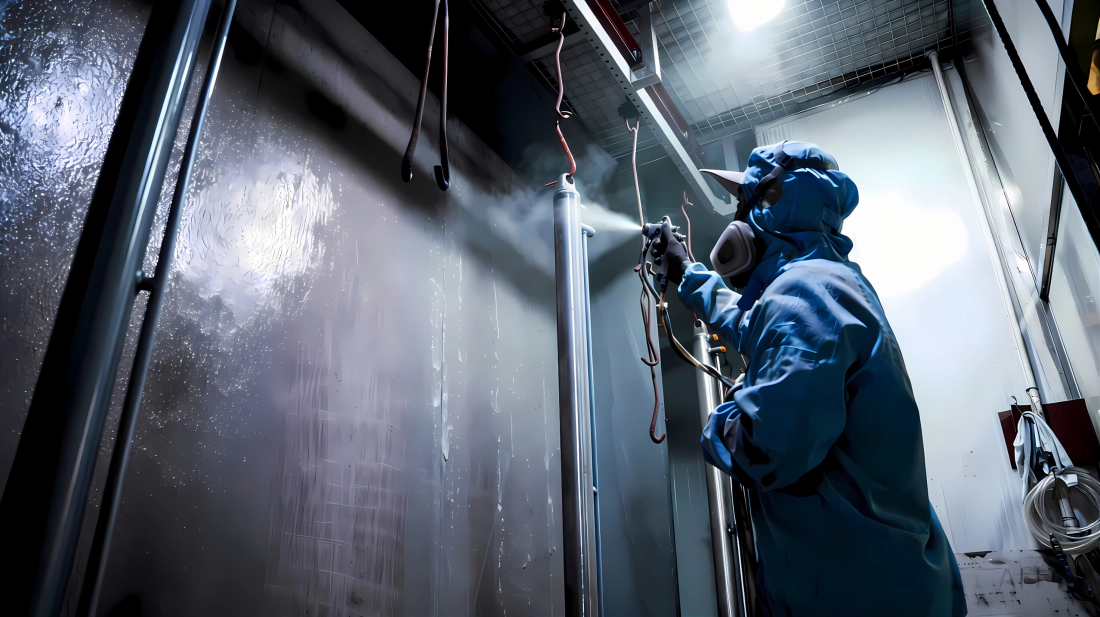
Electroless nickel plating is selected as the rod surface treatment for high-altitude pruning vehicle arm lifting cylinders on the basis of two properties that distinguish it from hard chrome plating in outdoor aerial work environments: coating uniformity and corrosion protection continuity. Hard chrome plating is deposited by an electrolytic process driven by current density — a process that produces chrome layers which are measurably thicker at the rod end edges and geometry transitions where current density concentrates than at the midpoint of the rod surface. For a cylinder rod required to present a consistent sealing interface to the rod seal and wiper across its full length and at geometry transition points, this chrome thickness non-uniformity creates both dimensional variation in the seal contact zone and accelerated seal wear at the transition areas where the chrome builds up to excess. Electroless nickel deposits through an autocatalytic chemical reaction that is independent of electrical current density, producing a coating of uniform thickness — within plus or minus 0.005 mm — across all rod surface features including end geometry transitions, cross-holes, and threaded sections that electrolytic chrome cannot coat consistently. This uniformity directly translates to consistent sealing surface quality along the full rod length, supporting seal performance and service life that chrome-plated rods in this geometry cannot reliably provide.
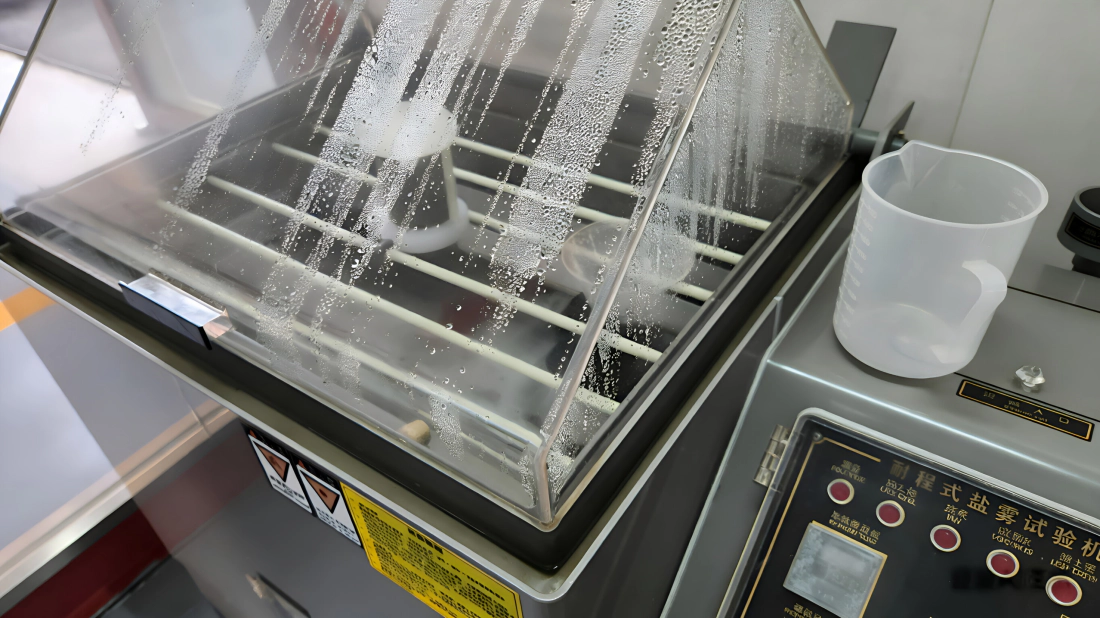
The corrosion protection performance of electroless nickel in outdoor high-altitude conditions is particularly relevant because high-altitude pruning vehicle cylinder rods spend extended periods partially extended — with a section of the rod outside the cylinder end cap and exposed to weather while the pruning arm holds a working position. Unlike equipment that retracts the cylinder fully to a covered or protected position when not working, pruning vehicles maintain the arm at intermediate positions for the duration of each tree trimming session, which may last several hours. During this time the weather-exposed rod zone accumulates rain, morning dew, urban airborne pollutants including vehicle exhaust compounds and particulates, pollen and organic material from the tree canopy environment, and the continuous high humidity that vegetated urban environments generate. Electroless nickel’s continuous, low-porosity barrier coating resists this combined atmospheric corrosion more reliably than hard chrome in unprotected outdoor exposure conditions — hard chrome’s inherent micro-cracking pattern, which is beneficial for lubricant retention in seal contact zones, simultaneously provides pathways for corrosive moisture to penetrate to the substrate at the micro-crack network level, initiating substrate corrosion that the chrome layer can conceal until it undermines the chrome adhesion from below.
The hardness of as-deposited electroless nickel — typically HV 500 to 700 — is lower than hard chrome’s HV 900 to 1,100, which represents a wear resistance trade-off that our engineering team addresses through post-deposition heat treatment for applications where the deployment environment analysis indicates elevated abrasive risk. Heat treatment at 200 to 300 degrees Celsius drives hydrogen out of the nickel structure and drives a phase transformation that raises nickel hardness to HV 900 or above — matching hard chrome performance while retaining all of electroless nickel’s uniformity and corrosion protection advantages. For high-altitude pruning vehicles operating primarily in urban or suburban boulevard environments where contamination reaching the cylinder rod is predominantly rainwater, airborne particulates, and organic material from tree canopy, as-deposited nickel hardness provides adequate seal interface performance. For vehicles operating in orchard environments where fine soil dust and agricultural particulate contamination is heavier, our engineering team recommends heat-treated electroless nickel to maximize both the corrosion protection and the abrasion resistance the rod surface presents to the wiper and rod seal contact zones.
Safety Factor Greater Than 3 and Extended Guide — The Structural Defense Against Wind-Induced Rod Bending
The requirement for structural safety factors exceeding 3 in high-altitude pruning vehicle arm lifting cylinders is established by the intersection of aerial work safety standards and the dynamic loading behavior that wind creates at operating heights. China’s national standard GB/T 9465 for mobile elevating work platforms, along with European standard EN 280 and ISO 18893 governing aerial work equipment internationally, specifies minimum structural safety factors for hydraulic cylinders in aerial access systems that reflect regulatory assessment of wind gust risk. The regulatory basis is straightforward: a wind gust significantly above the design wind speed can instantaneously impose lateral forces on the pruning arm and platform that exceed the design wind load by factors that only a safety margin above 3 against structural yield can accommodate without losing structural integrity. The consequence of cylinder rod yielding at height — a loss of arm position control with a person on or near the platform — makes the regulatory position on safety factor conservatism defensible and practically important rather than bureaucratic over-specification. Our structural calculations for each cylinder configuration verify the SF greater than 3 requirement against the specific boom arm geometry, rated payload, and the design wind speed class appropriate to the vehicle’s rated maximum operating wind speed, providing documentation that supports customers’ CE marking compliance and GB standard certification records.
The extended rod guide — with its 90 to 140 mm bearing length distributing the lateral load reaction at the rod exit — addresses the rod bending failure mode through a structural mechanism that is distinct from and complementary to the SF greater than 3 rod sizing. Where the larger rod diameter increases the rod’s intrinsic resistance to bending by raising the section modulus — the geometric parameter that determines bending stress for a given bending moment — the extended guide reduces the effective bending moment applied to the rod by shortening the unsupported cantilever length that creates the maximum moment at the rod-to-guide interface. Standard end-cap rod carrier designs provide 20 to 40 mm of lateral support contact length, leaving the rod in an effective cantilever condition over the unsupported span between the piston guide ring and the end-cap bearing. An extended guide of 90 to 140 mm shortens this cantilever span and creates a distributed lateral reaction over a contact area large enough to bring the peak contact pressure on the nickel-plated rod surface within the bearing pressure limits of the self-lubricating bronze guide material. Guide length and geometry are determined in our engineering process from the actual bending moment diagram of the specific boom arm configuration, matching the bearing surface to the load requirement rather than applying a standard dimensional selection that may under- or over-provide for the specific application.
The structural effect of combining SF greater than 3 rod sizing with extended guide design is multiplicative rather than additive, because the two mechanisms address different aspects of the rod bending failure condition. The SF greater than 3 rod diameter increases the rod’s capacity to resist bending stress — raising the load at which yielding occurs for any given moment. The extended guide reduces the moment that a given wind load applies to the rod at the critical cross-section — lowering the bending demand the wind imposes for the same lateral force magnitude. When both parameters are optimized together through the engineering process, the resulting structural margin against rod bending failure under the design wind gust condition can exceed the SF greater than 3 threshold by an additional margin that accounts for manufacturing variability and in-service factors — rather than just meeting the standard’s minimum at the design limit. For high-altitude aerial work applications where the consequences of structural failure at height are severe, this additional margin beyond the regulatory minimum is an engineering value that we build into our designs as a standard practice rather than an optional upgrade.
Application Scenarios — Where High-Altitude Pruning Arm Cylinders Work
High-altitude pruning vehicles are deployed across a range of arboricultural and vegetation management contexts that share the common requirement for safe, controlled aerial access to tree crown height. The pruning arm lifting cylinder enabling this access appears in machines ranging from compact urban boulevard pruners with 10 to 15 meter reach to large highway arborist vehicles working at 20 to 25 meters. The four primary deployment scenarios below represent the environments where our pruning arm lifting cylinders are most commonly specified — from China’s urban park and boulevard programs to international orchard management markets and mountain area vegetation clearance operations.

Urban Boulevard and Park Tree Pruning
Compact pruning vehicles operating in China’s urban parks, residential boulevard programs, and commercial district tree maintenance work at heights of 10 to 18 meters in environments where wind exposure varies from sheltered courtyard conditions to open boulevard corridors with significant wind tunnel effects between buildings. The pruning arm cylinder in these vehicles cycles frequently — urban tree crews may complete 50 to 80 arm positions per working day — and the nickel plating’s corrosion protection is tested continuously by rain, urban humidity, and the fine particulate contamination characteristic of busy urban environments.
Highway Corridor Arboriculture
Large pruning vehicles on China’s national and provincial highway networks work at heights of 15 to 25 meters in open corridor conditions where wind exposure is maximum and where the vehicle’s shoulder-mounted position adds chassis tilt components to the cylinder loading. These vehicles encounter the most demanding wind load conditions of any pruning application — open highway corridors with no shelter from prevailing winds, and vehicle speeds that add air flow to the wind-induced loading when repositioning between trees. The SF greater than 3 requirement is particularly important for highway arborist vehicles, where gust loading above the design wind speed is a regular operational reality rather than a rare event.
Orchard High-Reach Pruning Operations
Apple, pear, and walnut orchards in China’s Shaanxi, Gansu, and Shandong growing regions use high-reach pruning vehicles for canopy management, dormant-season pruning, and crown thinning at heights that conventional ladder equipment cannot safely access. In orchard environments, the combined loading on the pruning arm cylinder includes not only gravitational and wind components but also the reaction force from power pruning tools that generate vibration and impulse loads through the arm structure. Heat-treated electroless nickel plating is specified for orchard applications where fine soil dust contamination reaches the cylinder rod surface throughout the working season.
Mountain Area and Special Terrain Vegetation Management
Mountain area vegetation management in China’s Sichuan, Yunnan, and Guizhou highland regions uses pruning vehicles on terrain where slope and uneven ground add chassis tilt components to the cylinder loading that flat-terrain applications do not encounter. At mountain altitudes, wind conditions are more variable and gusts are more frequent and severe than at equivalent heights in lowland environments. The combination of terrain-induced chassis tilt, higher altitude wind exposure, and extended seasonal deployment in cold weather creates a combined specification requirement that our engineering team addresses through chassis tilt compensation in the moment arm calculation and cold-climate seal compound selection alongside the standard SF greater than 3 and extended guide design.
Engineering Advantages That Define Safety and Service Life in Aerial Pruning Applications
The service life advantage of correctly specified pruning arm lifting cylinders over standard industrial cylinder alternatives adapted to this application is most clearly visible in the rod bending failure statistics that aerial equipment operators accumulate across their fleets. Field data from high-altitude pruning vehicle fleets operated by Chinese municipal tree management authorities shows that cylinders specified without combined-load analysis — sized for gravitational load only without wind loading contribution — develop visible rod deflection within 18 to 30 months of operation on vehicles working at heights above 15 meters in open or semi-exposed locations. Once rod deflection begins, the failure cascade is progressive: uneven rod seal loading generates bypass leakage, leaking hydraulic fluid reduces system pressure, arm position holding performance degrades, and the compromised seal allows atmospheric moisture to reach the rod-cylinder interface, accelerating corrosion around the compromised seal geometry. By the time the deflection becomes operationally visible to the operator, the cylinder typically requires complete replacement rather than seal service alone.
Our cylinders with SF greater than 3 rod sizing and extended guide design have demonstrated service life exceeding five years without rod deflection events in municipal arborist fleet operation at working heights of 15 to 22 meters across China’s urban tree maintenance programs — a lifecycle improvement that reduces cylinder replacement costs, eliminates the safety-critical scenario of a cylinder failure with a person at height, and simplifies fleet maintenance scheduling by extending the interval between planned cylinder inspections. For municipal procurement programs managing multiple pruning vehicles over multi-year maintenance contracts, the difference between a cylinder specification that requires replacement at 18 to 30 months and one that operates for 5 or more years represents a meaningful direct cost reduction and a significant improvement in operational reliability.
| Feature | Our Cylinders | Standard Catalog Alternatives |
|---|---|---|
| Safety factor | Greater than 3, verified by structural calculation | 1.3 to 1.5 (standard industrial) |
| Rod sizing basis | Combined axial + bending + wind load analysis | Gravitational load only |
| Surface treatment | Electroless nickel — uniform, corrosion-resistant | Hard chrome — variable thickness, outdoor limitations |
| Guide bearing length | 90 to 140 mm extended guide | 20 to 40 mm standard end-cap carrier |
| Construction | Full-penetration welded; aerial safety-compliant | Tie-rod or threaded end-cap |
| Typical service life | 5+ years without rod bending in fleet operation | 18 to 30 months before rod deflection |
Custom Manufacturing — Engineering Aerial-Grade Cylinders From Your Machine Design Data
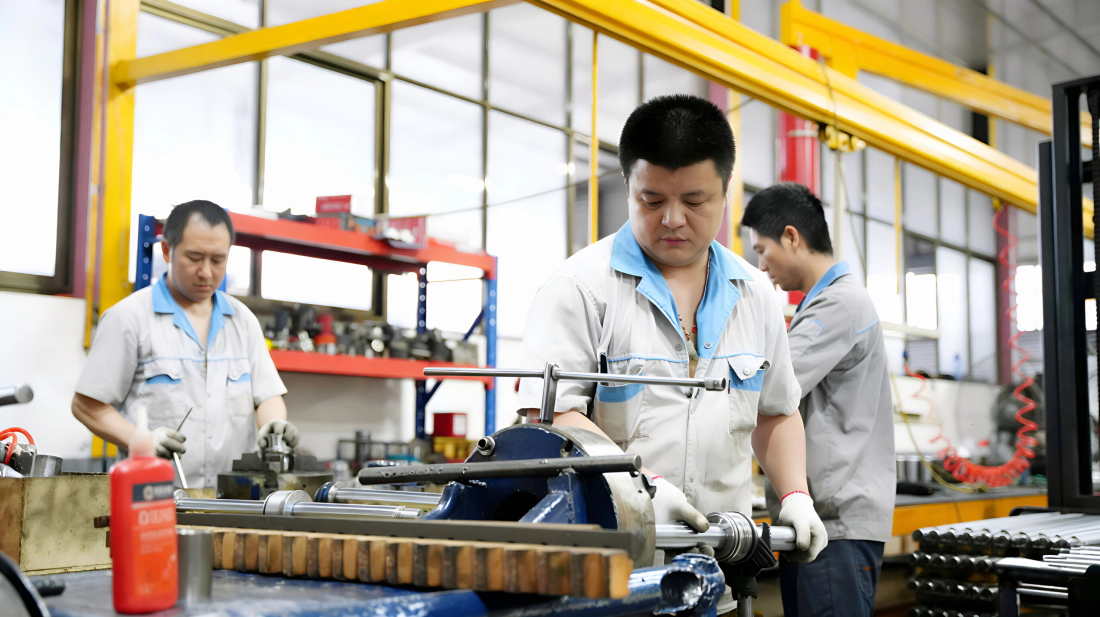
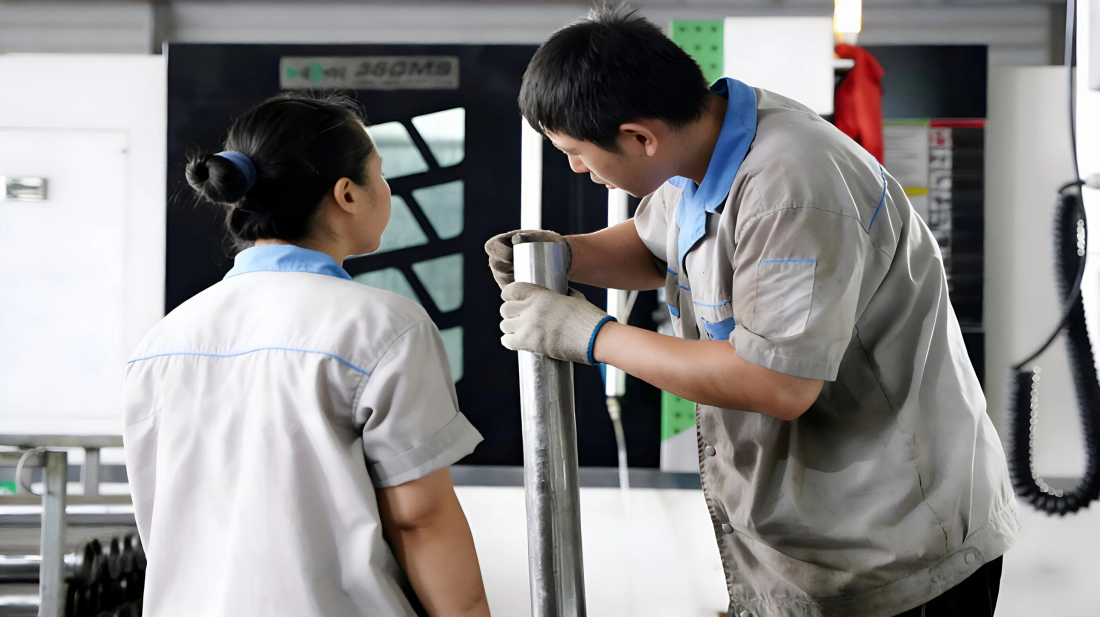
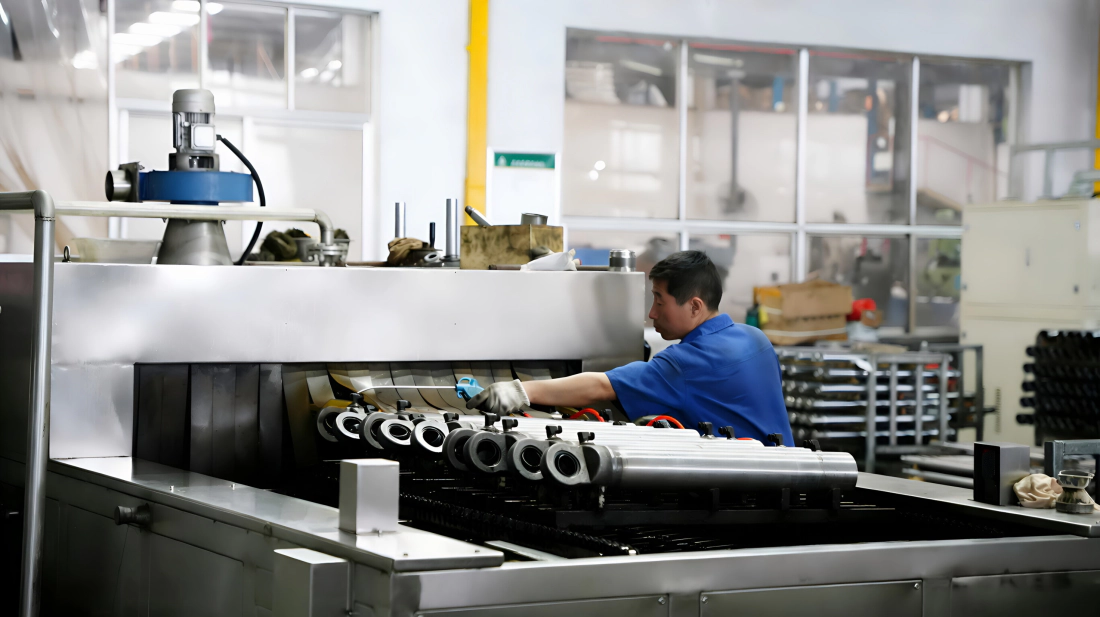
Our manufacturing facility operates cylinder production capability with CNC deep-hole boring centers handling bore diameters from 70 mm, precision honing equipment achieving bore surface finish to H7 tolerance, electroless nickel plating lines with temperature-controlled bath chemistry for consistent coating thickness uniformity, and structural load testing stations where SF greater than 3 verification testing can be performed on production units for customers whose safety compliance programs require destructive or load test evidence rather than calculation-only verification. The engineering team supporting custom pruning arm cylinder development includes specialists in aerial work platform hydraulics, structural safety factor analysis per Chinese and international standards, and electroless nickel process engineering — professionals who contribute integrated technical knowledge to the specification process rather than simply processing dimensional requirements. Documentation provided with each order includes 42CrMo material mill certificates, dimensional inspection records, nickel plating thickness measurement maps across the rod length, weld inspection records with ultrasonic and magnetic particle test results, pressure test certificates, and the structural safety factor calculation report verifying SF greater than 3 for the specific configuration and application load case. Learn more about our engineering team and production standards at our About Us page.
Pruning vehicle manufacturers developing new platforms or updating existing models with improved aerial capability are encouraged to engage our engineering team from the early design stage, when boom arm geometry and rated height parameters are being established but before structural design is locked. Early engagement allows cylinder bore, rod diameter, guide length, and mounting geometry to be determined alongside the boom arm structural design, ensuring that the cylinder’s SF greater than 3 requirement is met within the pruning arm’s spatial constraints and weight budget rather than requiring arm redesign after the cylinder specification is complete. Our team can work from conceptual boom geometry with estimated payload parameters to provide preliminary cylinder specifications and structural calculation summaries that help designers understand the safety factor implications of their boom arm geometry choices before committing to detailed design work.
Prototype cylinders for custom pruning arm configurations are available within 28 to 38 working days for most designs. Production lead times of 35 to 50 working days apply to serial production configurations, with expedited scheduling available for urgent program requirements. We supply cylinders with matching structural calculation reports ready for submission to certification bodies for CE marking, GB standard compliance, or customer in-house safety review — documentation that transforms the cylinder from a purchased component into a verified safety-system element in the customer’s aerial work platform certification program. Municipal procurement authorities in China evaluating cylinder specifications for fleet standardization or tender requirements are welcome to contact our engineering team for technical specification review and compliance documentation assessment.
Customer Success Stories — Pruning Arm Cylinders in High-Altitude Field Operation
Municipal Tree Management Authority, Guangdong Province
A municipal tree management authority in Guangdong Province operates a fleet of 24 high-altitude pruning vehicles serving urban boulevard and park tree maintenance programs across a major city’s green infrastructure. Their previous cylinder supplier’s units had developed rod deflection on 7 of the 24 vehicles within 22 months, all on the larger machines operating at 18 to 22 meters in the city’s open waterfront boulevard corridor where wind exposure is consistently higher than inland locations. Following root cause analysis identifying axial-load-only rod sizing as the cause, our team specified SF greater than 3 cylinders with 125 mm extended guides for the full fleet. Fleet-wide rod deflection incidents have not recurred in 42 months of subsequent operation across all 24 vehicles including the high-exposure waterfront units.
“Forty-two months, 24 vehicles, zero rod deflection — including the waterfront units that had been our worst performers. The wind load analysis changed everything about how we specify these cylinders.”
— Fleet Technical Director, Municipal Tree Management Authority, Guangdong Province, China
Arboriculture Equipment Manufacturer, Noord-Brabant Region
A Dutch manufacturer of high-reach arboriculture vehicles required pruning arm lifting cylinders that would meet EN 280 structural safety requirements for CE-marked aerial work platform equipment, with specific SF greater than 3 verification documentation suitable for submission to a notified body. Their existing Chinese cylinder supplier was unable to provide the structural calculation report format required by the EU notified body reviewing their CE marking dossier. Our engineering team prepared SF greater than 3 verification calculations per EN 280 methodology for the specific boom arm geometry, provided material certifications traceable to EN 10083 equivalents for the 42CrMo steel, and delivered complete nickel plating thickness mapping documentation. The manufacturer completed their CE marking certification process without technical objection from the notified body and has standardized our cylinders across three model variants in their current range.
“The EN 280 structural calculation documentation was provided in the format our notified body required. No technical objections, CE marking achieved on schedule. That is genuinely rare from a Chinese supplier.”
— Certification Engineer, Arboriculture Equipment Manufacturer, Noord-Brabant, Netherlands
Highway Corridor Vegetation Maintenance Authority, Shaanxi Province
A highway maintenance authority in Shaanxi Province manages roadside tree maintenance along 280 kilometers of national highway using a fleet of 9 large pruning vehicles operating at heights of 18 to 24 meters on open highway shoulders in a region with strong seasonal wind events. Previous cylinders had developed corrosion pitting on the chrome-plated rods visible at seasonal inspection within 14 months, concentrated at the weather-exposed rod zone corresponding to the typical working arm position. Switching to electroless nickel plating eliminated the corrosion pitting pattern on all vehicles through two full subsequent maintenance seasons. The authority also requested structural calculation reports for GB/T 9465 compliance review as part of their fleet safety audit program — documentation our team provided within the engineering review timeline.
“No corrosion pitting at either seasonal inspection — two years running. The nickel plating resolved the outdoor corrosion issue that chrome had not. The GB/T 9465 documentation also satisfied our safety audit requirement.”
— Equipment Safety Officer, Highway Corridor Maintenance Authority, Shaanxi Province, China
Frequently Asked Questions
+What type of hydraulic cylinder is best suited for a high-altitude pruning vehicle arm lifting system in Chinese urban boulevard and highway corridor arboriculture operations at heights above 15 meters?
A double-acting piston cylinder with welded 42CrMo construction, electroless nickel rod plating, structural safety factor greater than 3, and an extended rod guide of 90 to 140 mm bearing length is the specification that addresses all the requirements of high-altitude pruning arm lifting in Chinese urban and highway arborist operations. The double-acting design is essential for safe controlled lowering against wind loading. The SF greater than 3 requirement is mandated by GB/T 9465 for aerial work platforms and is not optional for regulated aerial equipment. The electroless nickel plating provides the uniform corrosion protection that outdoor cylinder rods operating in the weather-exposed zone at working height require across multiple seasonal maintenance programs. The extended guide addresses the rod bending failure mode that standard industrial cylinder specifications do not design against. Standard agricultural or construction equipment cylinders adapted to this application will typically miss at least one of these requirements.
+How much does a custom hydraulic cylinder with nickel plating and safety factor greater than 3 for a high-altitude pruning arm typically cost from a manufacturer in China, and what documentation is included?
Custom pricing for high-altitude pruning arm cylinders with SF greater than 3 and electroless nickel plating depends primarily on bore diameter, rod diameter, stroke, order quantity, and the documentation package required for the customer’s safety compliance program. Cylinders for aerial work platform applications typically carry a price premium over standard industrial cylinders of 20 to 40 percent, reflecting the higher material specification (42CrMo vs. carbon steel), more complex surface treatment (electroless nickel process engineering), extended guide manufacturing, and structural safety factor documentation cost. For production-volume orders, Chinese manufacturer pricing remains substantially more competitive than European or North American equivalents for equivalent specifications and documentation standards. The documentation package — material certificates, dimensional records, nickel plating thickness maps, weld inspection records, pressure test certificates, and SF greater than 3 structural calculation reports per GB/T 9465 or EN 280 — is included as a standard deliverable rather than an optional premium. Submit your boom geometry and compliance requirements for a specific quotation.
+Why is a safety factor greater than 3 required for hydraulic cylinders in high-altitude pruning vehicle arm lifting systems, and how does wind load at working height determine this requirement?
The SF greater than 3 requirement for high-altitude pruning vehicle arm lifting cylinders is established by GB/T 9465 in China and EN 280 internationally, based on the risk level inherent in aerial work operations. The specific driving factor is wind gust loading: at working heights of 15 to 25 meters, wind pressure on the pruning arm structure can momentarily exceed the design wind speed by factors that only a structural margin above 3 against yield can absorb without permanent deformation or structural failure. A safety factor of 1.3 to 1.5 — appropriate for ground-level industrial equipment where load exceedances above design are rare and controlled — is insufficient for aerial systems where wind gusts are an expected, unpredictable, and operationally unavoidable load amplification event. The consequence of cylinder rod yielding under a wind gust at height — uncontrolled platform motion with personnel on or near the arm — makes the higher safety factor a safety-critical requirement rather than conservative over-engineering. Cylinders for aerial work platforms that are not verified to SF greater than 3 do not comply with Chinese national standard requirements for this equipment category.
+Which rod surface treatment is better for hydraulic cylinders on high-altitude pruning vehicles in outdoor conditions — electroless nickel plating or standard hard chrome — and what are the practical differences?
Electroless nickel plating outperforms hard chrome in the specific outdoor corrosion exposure environment of high-altitude pruning vehicle cylinder rods for two practical reasons: coating uniformity and corrosion barrier continuity. Electroless nickel deposits through an autocatalytic process at uniform thickness across the entire rod surface — including end geometry transitions and cross-features that hard chrome’s electrolytic process cannot coat without developing thickness concentrations that affect seal performance. Electroless nickel also produces a lower-porosity barrier coating than hard chrome, which contains inherent micro-cracks that — while beneficial for lubricant retention at seal contact zones — create pathways for corrosive moisture to reach the steel substrate in prolonged outdoor exposure. For pruning vehicle rods that spend hours in the weather-exposed zone during each working session, this difference in atmospheric corrosion resistance is practically important: nickel-plated rods on high-altitude pruning vehicles typically show no corrosion indication at seasonal inspection, while chrome-plated equivalents in the same environment show pitting in the weather-exposed zone within 12 to 18 months. Hard chrome remains the more common choice for protected or indoor equipment where its higher hardness advantage is more relevant than its outdoor corrosion limitation.
+Where can I find a reliable hydraulic cylinder supplier in China that provides both custom engineering support and full safety factor documentation for high-altitude pruning vehicle arm lifting applications?
Chinese manufacturers with genuine aerial work platform hydraulic engineering capability — including SF greater than 3 structural verification, electroless nickel plating production, and compliance documentation for GB/T 9465 or EN 280 — are a specialized subset of the broader hydraulic cylinder manufacturing sector. Key indicators to look for: the supplier should perform structural safety factor calculation from your actual boom geometry rather than quoting from dimensional requirements alone; should offer electroless nickel plating as an engineered process with thickness mapping documentation rather than as a catalog option; and should provide structural calculation reports in a format accepted by Chinese safety authorities or European notified bodies. Our facility in China exports pruning arm lifting cylinders to arboriculture equipment manufacturers and municipal fleet operators across more than 40 countries, with documentation packages that have supported successful CE marking certification reviews at European notified bodies and GB standard compliance audits by Chinese municipal procurement authorities. Prototype lead times of 28 to 38 working days apply to most configurations.
+How does an extended rod guide prevent hydraulic cylinder rod bending on high-altitude pruning vehicle arm systems, and how long should the guide be for vehicles operating in high wind exposure conditions?
An extended rod guide prevents rod bending by distributing the lateral reaction force — the force the cylinder structure exerts on the rod to resist the wind-induced bending moment — over a larger bearing contact area and a more favorable structural geometry than a standard end-cap rod carrier provides. A standard end-cap guide of 20 to 40 mm contact length concentrates the full lateral reaction over a short contact zone at the end of the rod’s unsupported span, creating high contact pressure on the rod surface and a long effective cantilever from the guide to the piston — maximizing the bending moment at the critical cross-section. An extended guide of 90 to 140 mm shifts the lateral reaction point closer to the piston, reducing the effective cantilever length and distributing the reaction over a contact surface large enough to maintain contact pressure within the bearing material’s load limit. For high-altitude pruning vehicles in exposed wind conditions — highway corridors, waterfront locations, open hillside sites — guide lengths at the upper end of this range (120 to 140 mm) are appropriate, providing the structural margin that SF greater than 3 requires specifically for the lateral wind loading component. Guide length is determined by structural calculation from the actual boom geometry and design wind speed, not from a standard dimensional table.
Ready to Specify Your High-Altitude Pruning Arm Cylinder?
Send us your boom arm geometry, rated working height, maximum platform payload, operating wind speed class, and compliance standard requirements (GB/T 9465 or EN 280). Our engineering team will provide SF greater than 3 structural calculations and a cylinder specification proposal within three working days — at no cost. We serve arboriculture equipment manufacturers, municipal fleet procurement programs, and highway maintenance authorities across China and more than 40 international markets.
Full product range at hydrauliccylindersmanufacturer.com