If you have ever operated a motor grader on a final finish pass, you know the feeling. You are trying to shave off that last 5mm of base course, but the blade keeps “hunting.” It jumps, it drifts, or it just doesn’t react fast enough to your joystick inputs. It’s frustrating, and frankly, it burns fuel and patience. In my 18 years of diagnosing hydraulic headaches in road construction, the culprit often isn’t the operator—it’s the Blade Fine-Tuning Cylinder (or Shaping Cylinder). Most printers and purchasing managers treat this component like a standard agricultural ram, but that’s a massive mistake. This isn’t just pushing dirt; it’s about micro-displacement and holding a tolerance tight enough to land an airplane on.
We’ve seen the shift happening. The industry is moving from “eyeball grading” to 3D GPS Machine Control. This demands a cylinder that is smarter, stiffer, and faster. We have engineered a Double-Acting Servo Piston Cylinder specifically for this fine-tuning application. We utilize Stal stopowa construction (moving away from standard carbon steel) and integrate internal position sensors to close the loop. It’s the difference between drawing with a crayon and drawing with a laser.
👀 Walk Our Digital Production Floor
Seeing is believing. We don’t just assemble parts; we machine the alloy barrels and calibrate the sensors right here. We’ve digitized our factory so you can inspect our clean-room assembly area from your phone.
Take the tour:
The “Deadband” Killer: Engineering for Zero-Drift
Let’s get into the weeds. The biggest enemy of fine grading is “hysteresis” or mechanical slop. Standard cylinders use soft rubber seals that have high breakout friction. When the computer tells the blade to move down 1mm, the seal sticks, pressure builds, and then—pop—it jumps 5mm. That’s a ripple in your road.
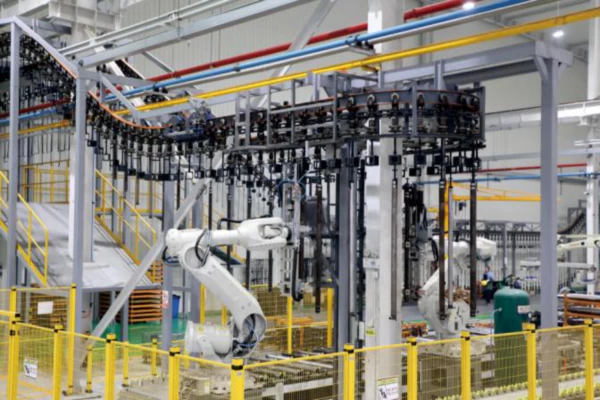
Our solution involves a complete redesign of the internal architecture. We use a Servo-Ready Piston with low-friction PTFE (Teflon) composite seals. These seals have almost zero stick-slip, allowing for smooth micro-adjustments. But the real game-changer is the integration of the Linear Position Sensor (LDT). We gun-drill the piston rod and install a magnetostrictive probe inside. This provides absolute position feedback to the grader’s ECU with a resolution of 5 microns.
Furthermore, we construct the barrel and rod from Stal stopowa o wysokiej wytrzymałości. Why? Because graders vibrate. A lot. Standard steel fatigues under the high-frequency vibration of a scraping blade. Alloy steel is stiffer, reducing the “spring effect” of the cylinder itself, which contributes to blade chatter.
| Funkcja | Standard Grade Cylinder | Our Servo Fine-Tune Spec |
|---|---|---|
| Feedback System | None (Open Loop) | Integrated LDT Sensor (Closed Loop) |
| Materiał pręta | Stal węglowa 1045 | 42CrMo Alloy Steel (Induction Hardened) |
| Seal Friction | High (Stick-Slip issues) | Ultra-Low (Smooth Micro-motion) |
| Position Accuracy | +/- 5mm | +/- 0.1mm |
| Drift Rate | Noticeable over time | Zero-Drift (with Lock Valve) |
Where Does Precision Matter Most?
While this cylinder fits into the blade lift/tilt linkage of a motor grader, its application isn’t just for pushing dirt. We see the highest demand in Final Trim (Finish Grading). When you are prepping a base for asphalt or high-speed rail, the tolerance is incredibly tight.

Another critical scenario is Slope Cutting. When the grader is crabbing sideways to cut a ditch bank, the side loads on the fine-tuning cylinder are immense. Standard cylinders bind up. Our design uses an extended guide band made of reinforced phenolic resin to absorb these side loads without damaging the sensor inside the rod. It effectively isolates the delicate electronics from the brute force of the earthmoving.
Case Study: The Outback Highway Upgrade
Klient: “Red Dust Civil” – Major road contractor in Western Australia.
Wyzwanie: They were upgrading a 200km stretch of haul road to highway standards. They were using Cat 14M graders with aftermarket GPS control. The problem? The hydraulics couldn’t keep up with the computer. The system would command a small correction, the cylinder would lag, and then overshoot. They were doing “re-work” on 30% of the sections, killing their profit margin.
Nasze rozwiązanie: We supplied a set of custom Servo-Hydraulic Fine-Tuning Cylinders.
- ✅ Aktualizacja: Integrated a Balluff magnetostrictive sensor compatible with their Trimble system.
- ✅ Valving: Mounted a high-response proportional valve directly on the cylinder port to minimize hose swelling lag.
- ✅ Ochrona: Used a heavy-duty chrome-over-nickel plating to resist the abrasive red dust.
Wynik: The re-work rate dropped to near zero. The grader could maintain grade at higher speeds (moving from 3rd gear to 5th gear on finish passes). The Site Superintendent, Bruce, told us, “It feels like a different machine. The blade just floats exactly where it needs to be.”
Field Feedback
“We used to guess the blade angle. With the internal sensors in these cylinders, I can see the exact slope on my screen. It takes the guesswork out.”
— Hans Mueller, Operator, Germany
“The drift issue kept me up at night. These cylinders lock solid. We parked the grader with the blade up over the weekend, and it hadn’t moved an inch by Monday.”
— Sarah J., Fleet Manager, USA
“Expensive? Yes. But paying for a second grading pass is more expensive. These paid for themselves in one project.”
— Liam K., Project Director, Ireland
Analiza strategiczna (SWOT)
Mocne strony
- Unmatched precision via internal sensing.
- Alloy steel construction reduces flex.
- Seamless integration with 3D Machine Control.
- Zero-drift sealing technology.
Słabości
- Higher initial investment cost.
- Requires calibrated ECU integration.
- Longer manufacturing lead time (gun drilling).
Możliwości
- Global boom in high-speed rail construction.
- Retrofitting older grader fleets with smart tech.
- Autonomous grading vehicle development.
Zagrożenia
- Complexity of electronic troubleshooting in remote areas.
- Supply chain shortages for sensor components.
Future Trends: The Brain in the Barrel
The hydraulic cylinder is no longer just a muscle; it’s becoming a sensory organ. The trend is moving rapidly towards Fully Autonomous Grading. We are currently testing cylinders with integrated “Health Monitoring” sensors that track seal wear, oil temperature, and vibration levels, sending that data to the cloud. This allows for predictive maintenance—fixing the cylinder *before* it loses precision. If you are still buying “dumb” cylinders for finish graders, you are building yesterday’s roads.
Built to Your Digital Specs
Here is the reality: You can’t buy these off the shelf at the local parts store. Every Machine Control System (Topcon, Trimble, Leica) has different sensor requirements (Voltage, PWM, SSI). We specialize in Custom Integration. You tell us the grader model and the control system you are running, and we build the cylinder with the correct sensor protocol and connector. No wire splicing, no adapters. Plug and Grade.
Często zadawane pytania (FAQ)
Why does my motor grader blade drift even with new seals installed?
Honestly, if you are seeing drift after a seal change, the issue often isn’t the seal itself—it’s the barrel expansion or valve leakage. In high-precision grading, even microscopic oil bypass causes “ripples” in the road. Our servo cylinders use a zero-leak poppet valve integration and stiffer alloy barrels to mechanically lock the fluid, eliminating that ghostly drift completely.
Can I retrofit a standard fine-tuning cylinder with a position sensor for 3D grading?
We get asked this a lot. While you can technically strap an external sensor on, it’s a nightmare in the dirt. The real solution is a “smart cylinder” where the magnetostrictive linear transducer is gun-drilled right down the center of the rod. It’s protected from rock impact and gives your Topcon or Trimble system 0.1mm accuracy.
How much does a custom servo-hydraulic blade cylinder cost compared to a standard unit?
You are looking at a premium, usually 2x to 3x the cost of a “dumb” cylinder. However, think about the rework costs. A standard cylinder might get you within 2cm; a servo cylinder gets you within 2mm. On a highway contract, avoiding a second pass pays for the cylinder in the first week.
What is the lead time for a custom alloy steel fine-tuning cylinder?
Since we machine the alloy steel and gun-drill the rods in-house for the sensors, we typically need about 25-30 days. It takes a bit longer than a generic part because we have to calibrate the sensor electronics to your specific machine’s ECU.
Do these cylinders handle the side-load when I’m banking a slope?
Absolutely. That side-load is the cylinder killer. We use an extended guide bushing design with composite wear rings that spreads that lateral force out. Plus, the 42CrMo rod material is significantly stiffer than standard carbon steel, resisting the “banana bend” effect.
Stop Guessing. Start Grading.
Upgrade to Servo-Hydraulic Precision and never rework a road again.