In rural China’s vast network of agricultural access roads — paths that wind through orchard zones, link village clusters to county highways, and run alongside irrigation canals — road maintenance vehicles carry out infrastructure work that determines whether harvest logistics function on schedule. The boom arm clearing system mounted on these vehicles handles fallen trees, displaced concrete barriers, and dense seasonal vegetation growth that would otherwise block the narrow lanes rural communities depend on. Removing these obstacles requires a boom arm that can lift, extend, precisely position, and forcefully retract a heavy clearing attachment across unpredictable terrain conditions, cycle after cycle, throughout a full working season without unscheduled maintenance.
At the structural core of every functional boom arm is a hydraulic cylinder executing that lifting and controlled lowering. That cylinder absorbs shock whenever the clearing attachment contacts an embedded or rooted obstacle at operating speed. It cycles through thousands of extension-retraction events across each season. It operates surrounded by fine silica dust lifted from dry road surfaces, moisture from irrigation spray drift, and mechanical vibration transmitted through the vehicle chassis across uneven ground. These combined stressors define one of the more demanding duty cycles a hydraulic cylinder can encounter — and they explain why our boom arm lifting cylinders are engineered as dedicated, application-specific components rather than adapted catalog selections.
Our double-acting piston hydraulic cylinders for agricultural road maintenance vehicle boom arms are built on a 42CrMo chromium-molybdenum alloy steel material system, welded construction that eliminates mechanical joint vulnerabilities, and hard chrome rod finishing that sustains sealing performance in high-dust field environments. Every cylinder we supply for this application reflects the specific failure modes — rod bending, seal contamination bypass, and end-of-stroke impact damage — that field experience in agricultural road clearing operations has identified as the primary service life limiters. We manufacture these cylinders in China for equipment builders and fleet operators across more than 40 countries, with engineering support available from the earliest stage of boom arm design.
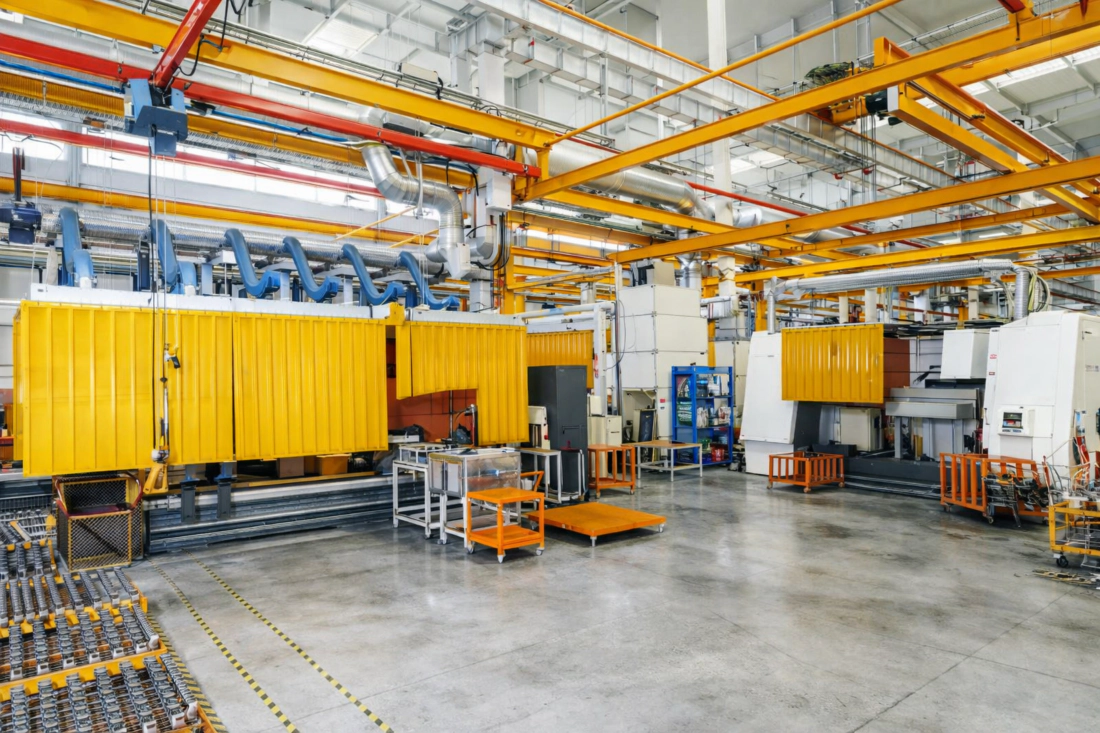
🏭 Tour Our Manufacturing Facility — Virtually
We welcome procurement engineers, equipment designers, and fleet buyers to explore our production facility from anywhere in the world. Walk through our CNC honing lines, deep-hole boring centers, and chrome plating stations, then connect with our engineering team to discuss your specific boom arm cylinder requirements.
How a Double-Acting Piston Cylinder Drives Boom Arm Performance
The double-acting piston cylinder generates controlled hydraulic force in both the extension and retraction directions by routing pressurized fluid to alternate sides of the piston through dedicated port channels. For boom arm lifting on agricultural road maintenance vehicles, bidirectional hydraulic authority is essential: the operator requires full hydraulic control to lower the boom arm against resistance — pressing a cutting head into dense brush, or holding a grappling claw in a partially-closed position against spring-back force — not just to raise it. Gravity-return designs that rely on boom arm weight to drive retraction cannot provide this control precision and are entirely unsuitable for debris-clearing operations where the arm may need to hold position or descend against resistance.
Our welded cylinder construction eliminates the end-cap threading and tie-rod interfaces that represent the most common structural weak points in cylinders subjected to the lateral and bending loads generated at partial extension. Full-penetration weld joints distribute stress across the complete perimeter of each structural connection, and weld quality is verified by ultrasonic testing and magnetic particle inspection on every production unit. The assembled cylinder is then pressure-tested to 1.5 times rated operating pressure before any seals or end fittings are installed, confirming structural integrity under real load conditions rather than relying on dimensional inspection alone. Every hydraulic cylinder that leaves our facility has been validated as a pressure vessel before it becomes a machine component.
The piston assembly is fitted with precision-machined bronze guide rings that maintain rod concentricity through the full stroke range, preventing metal-to-metal contact at the cylinder bore wall under lateral loading. This guidance function is particularly important in boom arm cylinders that regularly operate at partial extension — the mechanical condition where the unsupported rod length is maximum and lateral load-induced deflection is highest. The combination of welded barrel integrity, piston guidance, and oversized rod diameter creates a cylinder that maintains geometric accuracy under the combined axial, lateral, and bending loads that define agricultural road clearance operation.
Standard Technical Specification Range — Boom Arm Lifting Cylinders
The following parameters represent our standard production range for agricultural road maintenance boom arm hydraulic cylinders. All dimensions are fully configurable through our custom engineering process, and the values listed reflect the starting point for application-specific specification rather than fixed catalog limits.
| パラメータ | 仕様 | エンジニアリングノート |
|---|---|---|
| アクションタイプ | Double-acting piston | Full hydraulic control in both directions |
| 工事 | Welded (full-penetration) | No threaded end-cap joint vulnerabilities |
| ボア径 | 50 mm – 280 mm | Standard boom arm range: 80–160 mm |
| ロッド径 | 35 mm – 200 mm | Oversized vs. axial load calc. (+20–30%) for bending resistance |
| ストローク範囲 | 150 mm – 3,000 mm | Custom intermediate strokes available |
| 動作圧力 | Up to 35 MPa | Test pressure: 1.5× rated pressure |
| シリンダー材質 | 42CrMo合金鋼 | Tensile strength 1,000–1,250 MPa (Q+T) |
| ロッド材質 | 42CrMo, induction-hardened | Surface hardness HRC 54–60 |
| 表面処理 | Hard chrome plating (micro-crack) | Thickness 0.025–0.050 mm; hardness HV 900–1,100 |
| Rod Surface Finish | Ra 0.2–0.4 µm | Ground and polished before chrome plating |
| シール材 | Polyurethane (standard); NBR / FKM optional | PU selected for abrasion resistance in dust environments |
| クッション性 | Internal, adjustable (needle valve) | Both-end cushioning standard for impact applications |
| 動作温度 | -20℃~+80℃ | Extended low-temp seals available for northern regions |
| 取り付けオプション | Clevis, flange, foot, trunnion | Custom mounting geometry available with drawings |
| Quality Inspection | UT weld + MPI + pressure test (100%) | Full inspection documentation provided with shipment |
42CrMo Material System — Why Alloy Steel Determines Long-Term Service Life
The selection of 42CrMo chromium-molybdenum alloy steel for both the cylinder barrel and piston rod in our boom arm lifting cylinders reflects the specific failure mechanics of agricultural road clearance operation. When a road maintenance vehicle boom arm clearing attachment contacts a rooted obstacle — a tree stump embedded in a road shoulder, a concrete fragment partially buried beneath vegetation — the impact force is transmitted through the attachment mounting point, along the boom arm structure, and directly into the cylinder’s piston rod as a combined axial and bending load. Carbon steel rods sized for the axial load alone may be undersized for this combined loading, leading to progressive rod deflection and, eventually, irreversible rod bending failure that terminates cylinder service life.
42CrMo provides tensile strength in the range of 1,000–1,250 MPa after quenching and tempering, compared to approximately 600–700 MPa for common S45C or 1045 carbon steel in equivalent form. This represents approximately a 40–60% increase in yield strength — directly translating to higher resistance to the rod deflection that precedes bending failure under lateral obstacle impact. The material’s chromium content improves through-hardening during heat treatment, ensuring that wall sections across the full barrel thickness achieve consistent mechanical properties rather than leaving a soft core that limits burst pressure performance.
The molybdenum alloying element provides the fatigue performance benefit that distinguishes 42CrMo in cyclic loading applications. Agricultural road maintenance boom arms may complete 800–1,500 extension-retraction cycles per working day across seasonal operations lasting 120–200 days — accumulating multi-million cycle fatigue histories that challenge carbon steel cylinders operating at near their monotonic strength limits. 42CrMo’s fatigue limit, expressed as a fraction of its ultimate tensile strength, is meaningfully higher than standard carbon steels, which is why it has become the dominant material choice among hydraulic cylinder manufacturers serving heavy agricultural and construction equipment markets globally.
Hard Chrome Plating — Sealing Integrity in High-Dust Agricultural Environments
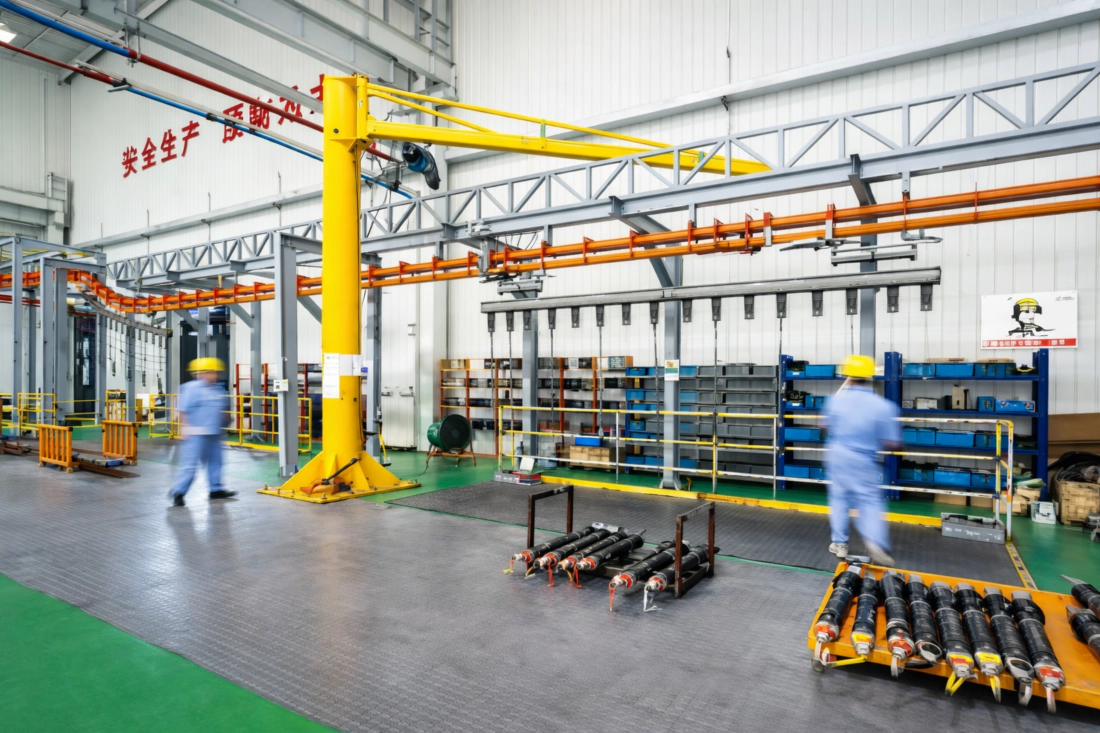
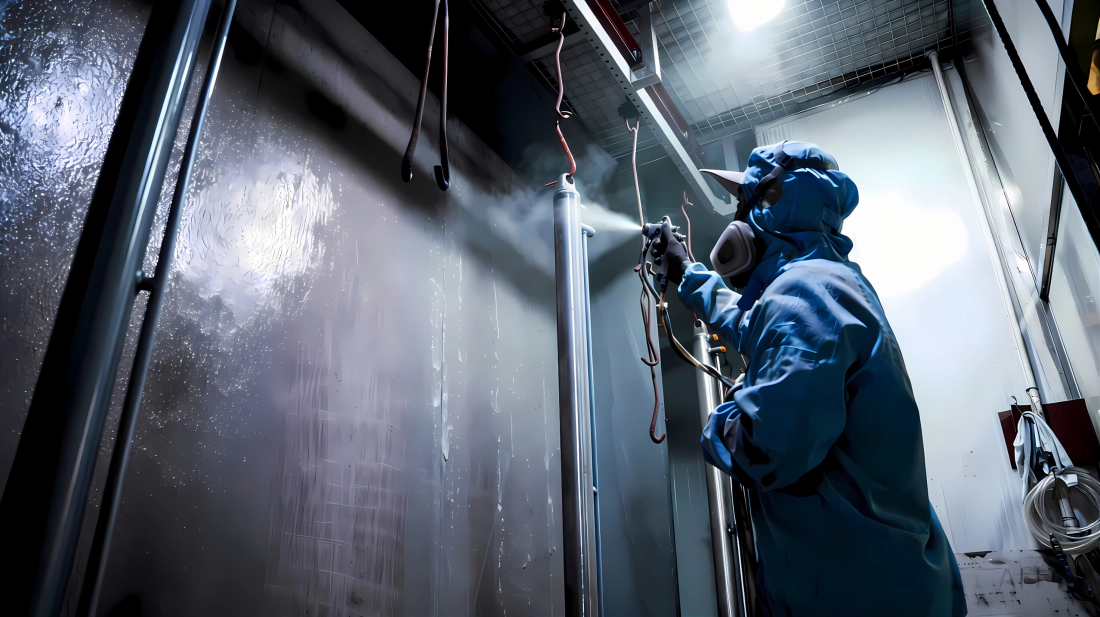
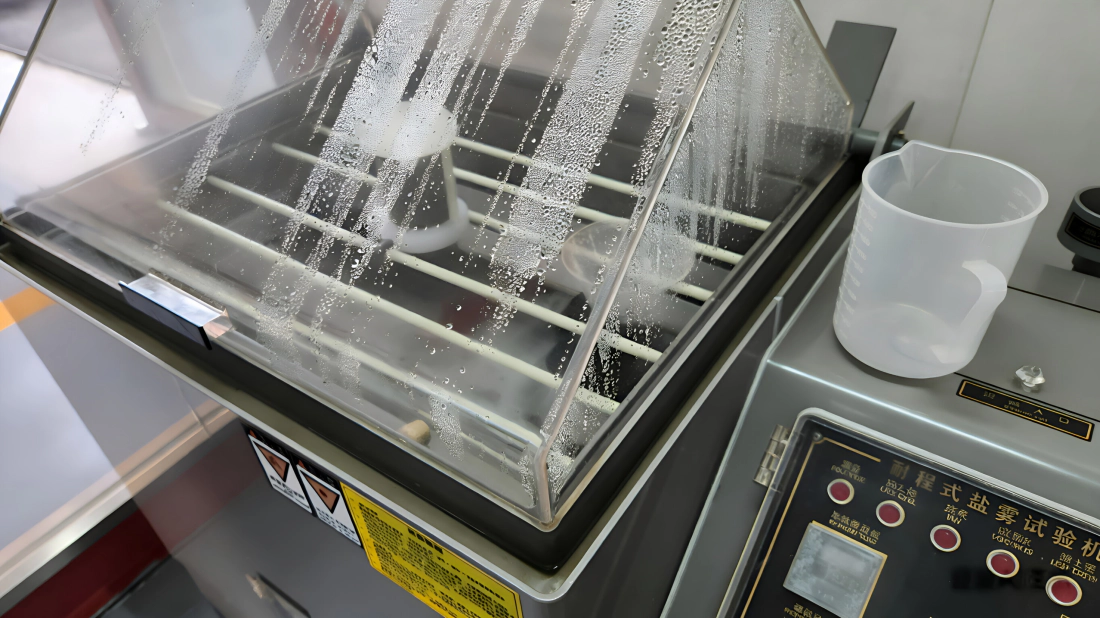
Agricultural road maintenance environments generate airborne dust with particle size distributions that include fine clay minerals and silica fractions below 10 microns — small enough to penetrate standard wiper seal gaps when the seal lip is not continuously maintained against a clean, precisely-finished rod surface. The hard chrome coating applied to our piston rods — 0.025 to 0.050 mm thickness, surface hardness HV 900–1,100 — creates the durable, corrosion-resistant surface that sealing systems require to perform reliably across extended field deployment without maintenance access between seasonal service intervals.
Our plating process uses micro-crack chrome chemistry that produces a controlled network of fine surface channels within the chrome layer. These micro-cracks retain a thin lubricating film that supports the hydrodynamic lubrication mechanism preventing rod seals from running dry on each extension-retraction cycle. This property is particularly important in high-dust environments, where contamination management is continuously challenged by airborne particles that tend to accumulate on the rod surface between the wiper and rod seals. Conventional smooth chrome cannot hold the same lubricant film volume, resulting in accelerated seal lip wear and earlier onset of rod seal bypass leakage — the most common symptom of seal failure in agricultural cylinder applications.
Chrome plating thickness is verified on each finished rod using calibrated magnetic induction gauges, with measurement points at regular intervals along the rod length and at both ends where thickness uniformity is most difficult to maintain during electroplating. Any rod measuring below the 0.025 mm minimum at any point is returned for reprocessing before entering final inspection. This verification discipline — applied to every production rod rather than on a statistical sample basis — is one of the quality practices that distinguishes our manufacturing process from lighter-duty cylinder suppliers relying on periodic batch testing.
Where These Cylinders Work — Agricultural Road Maintenance Scenarios Across China and Export Markets
Rural road maintenance vehicle boom arm cylinders support a wider range of operational contexts than the primary obstacle-clearing function might suggest. County-level road maintenance programs in China’s agricultural provinces — Sichuan, Yunnan, Guangdong, Henan, Heilongjiang, and others — operate these vehicles throughout the full agricultural calendar, with boom arm configurations adapted to seasonal task requirements that impose different load profiles on the lifting cylinder.

🌿 Roadside Vegetation Cutting
Spring and early summer operations place the boom arm cylinder under continuous cyclic load at moderate force levels but high cycle frequency. The cutting head runs continuously across variable vegetation height, requiring constant micro-adjustment of the arm’s lift position through rapid proportional valve cycling. Cylinder seal durability and consistent rod surface finish quality determine whether this high-frequency operation can run through a full day without developing bypass leakage.
🌀 Post-Storm Debris Clearance
After typhoons or severe weather events, cycle frequency drops but peak forces increase substantially as the clearing attachment encounters major fallen material — entire tree sections, large embedded branches, displaced road furniture. In these conditions, the cylinder must provide sustained full bore-area force at rated operating pressure, with the cushioning system absorbing repeated high-energy end-of-stroke impacts without thermal accumulation causing cushion performance degradation.
⛰ Mountain Agricultural Roads
Operations in Yunnan, Sichuan, and Guizhou add terrain-induced vibration to the operating profile, transmitted through the vehicle chassis to the cylinder mounting points as broadband mechanical noise. This cumulative vibration affects mount fatigue, piston wear, and seal compression set at a rate significantly higher than flat-terrain equivalents. Our cylinders for mountain-region applications specify reinforced mounting flanges and an extended cushion calibration range to address this environmental factor directly.
❄ Northern Winter Operations
Snow removal boom arm configurations in Heilongjiang, Jilin, and Inner Mongolia impose rapid cycling under heavy inertial loads combined with low ambient temperatures that reduce hydraulic fluid viscosity index and affect seal elasticity. Our northern-region cylinder specifications include extended low-temperature seal compounds rated to -35°C and use of low-viscosity hydraulic fluid-compatible sealing geometries to maintain performance through cold-start operation.
Engineering Advantages That Define Performance Over Full Service Life
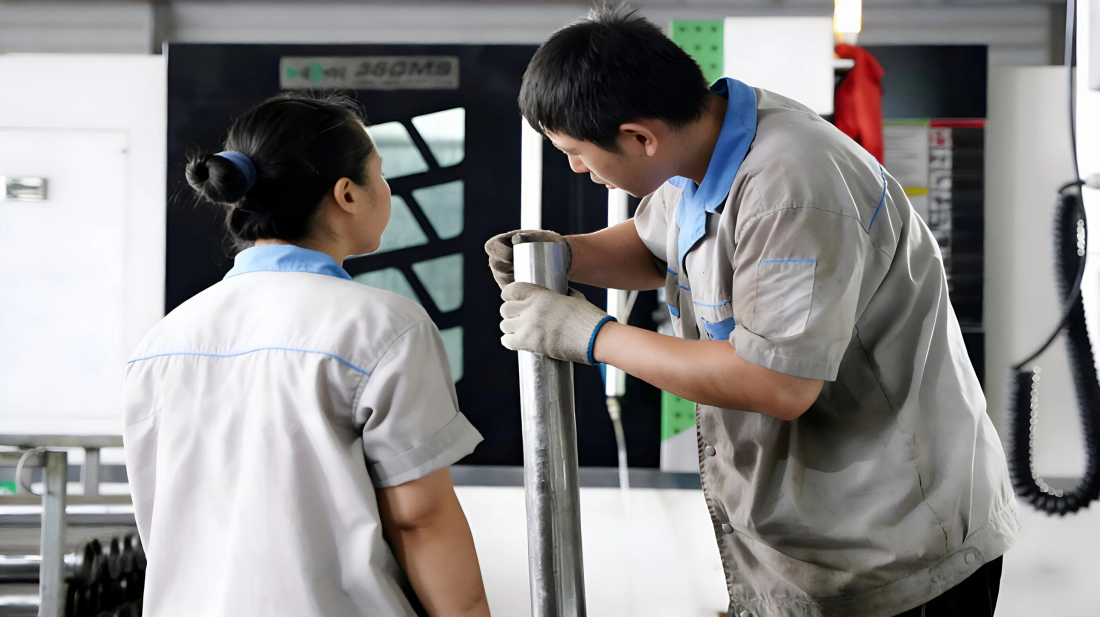
The rod bending failure mode that terminates service life in undersized boom arm cylinders follows a predictable mechanical sequence: the cylinder’s piston rod enters a cantilever bending condition when the boom arm experiences lateral force from obstacle contact at partial extension. A rod correctly sized for the application’s maximum side load — calculated from the boom’s geometry, maximum attachment weight, and expected obstacle impact force — survives these events without permanent deformation. Our standard approach for agricultural road maintenance boom arm cylinders begins with rod diameters 20–30% larger than the pure axial load calculation requires, specifically to address this side-load scenario. This is not conservative over-engineering; it reflects the actual stress state the rod experiences in field use, which axial-load-only sizing models systematically underestimate.
Internal end-of-stroke cushioning — adjustable through an accessible needle valve without requiring cylinder disassembly — absorbs the kinetic energy of the moving piston and rod assembly as it approaches the end cap under load. Each boom arm has a specific maximum operating speed and maximum load combination that determines the peak kinetic energy arriving at end-of-stroke. Our cushioning specification process matches the cushion geometry, metering profile, and adjustment range to the specific machine’s operating envelope, so the vehicle operator has a meaningful adjustment range between cushion settings appropriate for vegetation cutting speed and settings calibrated for obstacle clearance work — rather than a single factory setting that is a compromise between both.
Polyurethane rod seals replace standard nitrile rubber as the default choice for agricultural road maintenance applications. The abrasion resistance of polyurethane against fine particulate contamination — the mechanism by which dust that bypasses the wiper seal gradually wears the rod seal lip — is substantially higher than NBR, extending the seal replacement interval under the dust exposure levels typical of dry rural road operations. Polyurethane’s compatibility with standard mineral-based hydraulic fluids used across agricultural equipment makes this a direct substitution that requires no system modification.
| 特徴 | Our Cylinders | Generic Catalog Alternatives |
|---|---|---|
| Rod material | 42CrMo, induction-hardened | S45C or 1045 carbon steel |
| Rod sizing strategy | Combined axial + lateral load | Axial load only |
| Chrome plating process | Micro-crack, 0.025–0.050 mm, 100% gauged | Conventional, batch-tested only |
| Seal compound | Polyurethane (PU) — abrasion-resistant | 標準NBR |
| クッション性 | Adjustable, application-calibrated | Fixed factory setting |
| Weld inspection | UT + MPI, 100% of units | Visual only, sampled |
Custom Manufacturing Capability — From Engineering Brief to Finished Cylinder
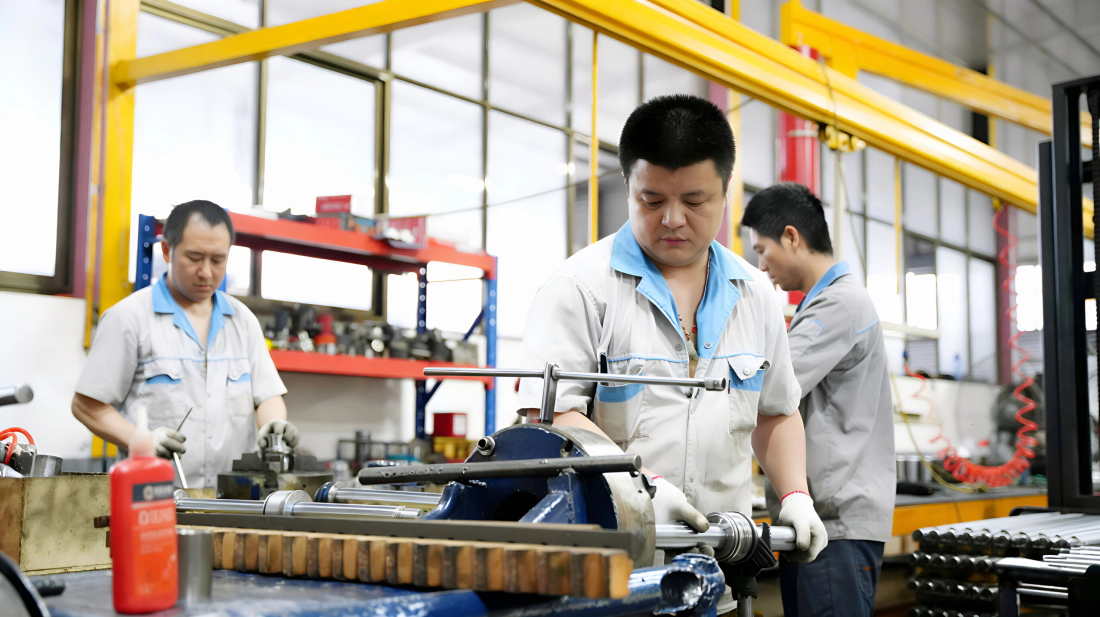
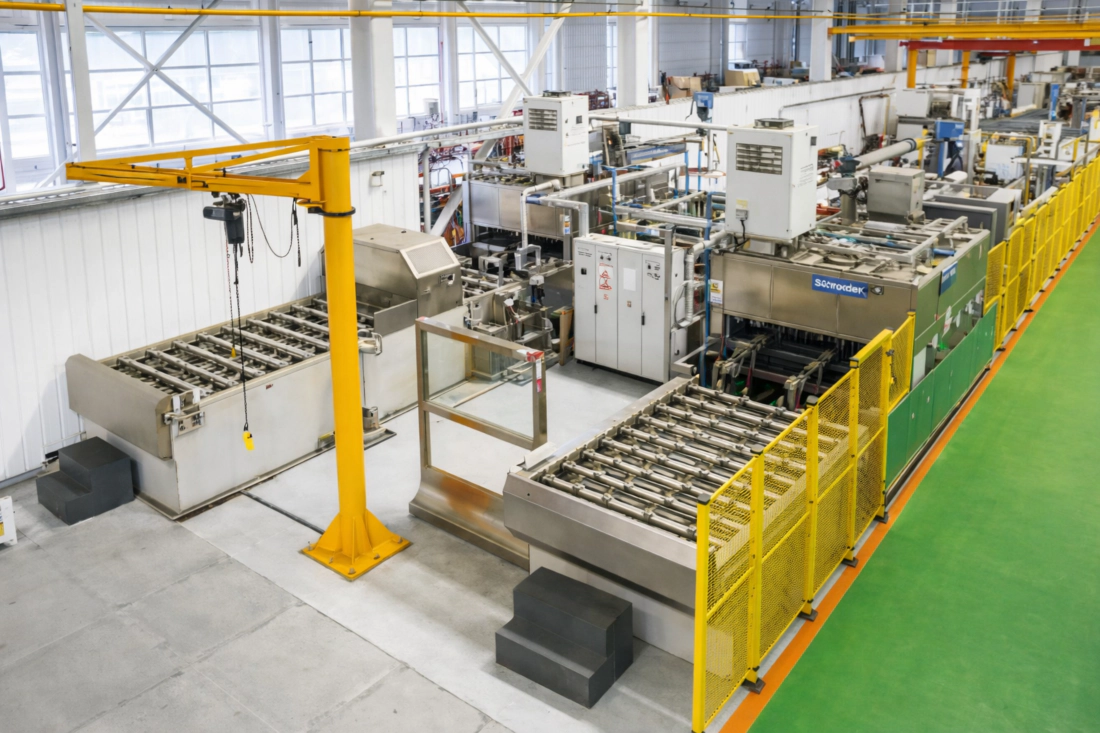
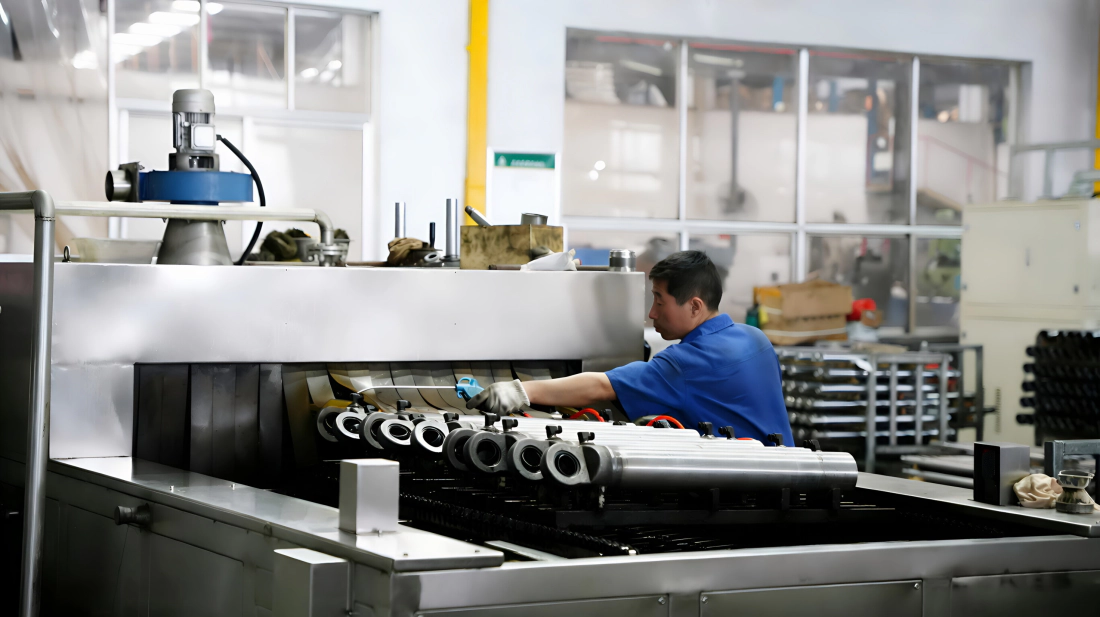
Our manufacturing facility in China operates across 18,000 square meters of dedicated production space, with CNC deep-hole boring centers, precision honing lines, automated hard chrome plating systems, and coordinate measuring equipment that maintains dimensional consistency across production volumes ranging from prototype single units to batch orders exceeding 500 cylinders. The engineering team supporting custom boom arm cylinder development includes mechanical engineers experienced in agricultural equipment dynamics, hydraulic system design, and failure mode analysis — professionals who engage with machine builders’ design requirements rather than reading from standard product specifications.
Customization engagement begins with the machine builder’s boom arm geometry and load requirements. Our team generates cylinder specification proposals covering bore size, rod diameter, stroke, operating pressure rating, port position, cushioning characteristics, and mounting geometry — all presented with complete dimensional drawings in DXF and STEP formats compatible with the customer’s CAD environment. Customers planning new road maintenance vehicle platforms are encouraged to involve our engineering team at the boom arm design stage, before structural dimensions are locked. Early engagement allows the cylinder specification to be co-optimized with the boom arm structural design, avoiding the constraint cycles that arise when either component must be retrofitted to accommodate the other’s dimensions after both are designed.
Prototype cylinders for most custom configurations are available within 25–35 working days. Serial production lead times of 30–50 working days accommodate most equipment manufacturer procurement schedules, with expedited processing available for urgent program requirements. We provide complete material certifications, dimensional inspection records, pressure test certificates, and chrome plating thickness measurement data with every order — documentation that supports equipment manufacturers’ own quality assurance records and export compliance requirements. Our production documentation standards are maintained for customers supplying equipment to CE-marked European markets and other regulated jurisdictions. Learn more about our company history and engineering capabilities at our About Us page.
Customer Success Stories — Field Performance Across Three Continents
Municipal Road Maintenance Contractor, Minas Gerais
A road maintenance contractor operating 22 vehicles across Brazil’s Minas Gerais agricultural region came to us after experiencing repeated piston rod bending failures on their existing boom arm cylinders during seasonal cutting operations. The original cylinders used 80 mm rod diameter in standard carbon steel construction. Our engineering team specified 100 mm 42CrMo rods with hard chrome finish and reinforced clevis mounting flanges. After 18 months of operation covering approximately 340 kilometers of rural road corridor, the customer reported zero rod bending failures. Seal replacement intervals extended from 6 months to over 14 months — directly reducing maintenance crew workload during peak operational periods.
“Zero rod failures in 18 months, and our maintenance schedule is half what it was. That’s the result we needed.”
— Equipment Manager, Road Maintenance Contractor, Minas Gerais, Brazil
Agricultural Infrastructure Bureau, Yunnan Province
An agricultural infrastructure operation in Yunnan Province required boom arm cylinders performing reliably through typhoon-season debris clearance on mountain agricultural access roads with grades exceeding 15%. The combination of steep terrain, heavy debris loads, and high ambient dust concentration had caused seal failures in their previous supplier’s cylinders within two months of seasonal deployment. Our cylinders — specified with polyurethane seals, micro-crack chrome rods, extended cushion range, and mountain-terrain mounting reinforcement — completed a full 8-month clearing season without a single seal replacement or unplanned service intervention. The operating team subsequently specified our cylinders for their entire county fleet renewal program.
“Eight months on Yunnan mountain roads without a service call. That is a first result for this application in our fleet.”
— Operations Director, Agricultural Infrastructure Bureau, Yunnan Province, China
Agricultural Contracting Business, Riverland, South Australia
An agricultural contracting business operating boom arm clearing equipment across orchard access lanes in South Australia’s Riverland region selected our cylinders for a fleet of 8 new vehicles. The contractor’s specific concern was piston rod corrosion from irrigation system overspray during working season — a problem that had required rod replacement at 14-month intervals on their previous equipment. Our hard chrome plating specification, combined with external rod seal wiper design matched to the expected overspray contamination level, provided corrosion resistance that eliminated this scheduled replacement cost. All 8 vehicles were delivered within our committed lead time, and the fleet completed its first full season without any cylinder-related service requirements.
“Lead time, documentation quality, and field performance all matched what was quoted. We’re specifying these cylinders across our entire fleet going forward.”
— Fleet Manager, Agricultural Contracting Business, South Australia
よくある質問
▶
What type of hydraulic cylinder works best for agricultural road maintenance vehicle boom arm lifting systems operating in dusty rural field conditions?
Double-acting piston cylinders with welded construction are the recommended choice for agricultural road maintenance boom arm lifting. The double-acting design provides full hydraulic authority in both extension and retraction directions — essential for controlled lowering of heavy clearing attachments against resistance. Welded construction eliminates the threaded and tie-rod joints that become structural weak points under the lateral and bending loads generated at partial extension during obstacle contact. For dusty field conditions specifically, selecting a cylinder with micro-crack hard chrome rod plating (rather than conventional smooth chrome), polyurethane rod seals (rather than standard NBR), and a dust-excluding wiper seal geometry substantially extends seal service intervals compared to standard catalog cylinders adapted from less demanding applications.
▶
How much does a custom double-acting hydraulic cylinder for a rural road clearance boom arm typically cost, and what affects the price from a Chinese manufacturer?
Custom hydraulic cylinder pricing for agricultural road maintenance boom arm applications depends on bore diameter, rod diameter, stroke length, operating pressure rating, material specification, and order quantity. For typical boom arm lifting cylinders in the 80–130 mm bore range with 42CrMo construction and hard chrome plating, unit pricing at production quantities (50+ units) is substantially lower than equivalent cylinders sourced from European or North American manufacturers — with lead times of 30–50 working days for serial production runs. Prototype pricing for single units or small-batch engineering samples is higher per unit but remains competitive. We recommend contacting our engineering team with your specific bore, stroke, and pressure requirements to receive an accurate quotation rather than relying on published price ranges that cannot account for configuration-specific variables.
▶
Which cylinder rod material performs better for boom arm applications — 42CrMo alloy steel or standard 45-grade carbon steel — and is the cost difference justified for agricultural equipment?
42CrMo alloy steel outperforms S45C (45# carbon steel) for boom arm cylinder piston rods in agricultural road maintenance applications by a significant margin. The yield strength advantage of 42CrMo — approximately 40–60% higher after comparable heat treatment — directly translates to resistance against the rod bending that terminates service life when obstacle impact loads are applied laterally at partial extension. For agricultural road maintenance applications where the boom arm regularly contacts embedded obstacles, the cost premium for 42CrMo rod material (typically 15–25% higher material cost) is recovered within the first avoided rod replacement event. Combined with the improved induction hardenability of 42CrMo — which produces a more consistent and deeper hardened layer that better supports chrome plating adhesion — the total lifecycle cost of 42CrMo cylinders is consistently lower than carbon steel alternatives in high-impact field applications.
▶
Where can I find a reliable hydraulic cylinder supplier in China that provides full custom engineering support for boom arm configurations on agricultural road maintenance equipment?
China has a well-developed hydraulic cylinder manufacturing sector, and distinguishing application-engineering-capable manufacturers from general production houses requires attention to a few key indicators: whether the supplier provides bore-and-stroke-only quotations or requires application load data to develop specifications; whether material certifications (mill certs for 42CrMo, for example) are provided as standard; and whether the supplier’s engineering team discusses failure modes, not just dimensions. Our facility, based in China, ships custom agricultural boom arm cylinders to equipment manufacturers in more than 40 countries and provides complete dimensional drawings, material certifications, and inspection documentation with every order. We welcome requests from equipment designers at any stage of their development process — early-stage concept discussions are as appropriate as requests for final production pricing.
▶
When should I schedule piston rod seal replacement on a hydraulic cylinder used in an agricultural road maintenance vehicle boom arm, and what signs indicate seal wear before full failure?
Seal replacement intervals for agricultural boom arm cylinders vary with operating conditions, but early replacement indicators include: visible hydraulic fluid film on the rod surface beyond a very thin lubricating layer (indicating rod seal bypass rather than normal surface film); contaminated return-line fluid (indicating ingested dust bypassing the wiper seal); and reduced cylinder end-of-stroke positioning accuracy (indicating cushion seal degradation). Under high-dust agricultural road conditions with polyurethane rod seals and properly maintained chrome rod surfaces, seal replacement intervals of 1,500–2,500 operating hours are achievable. Cylinders using standard NBR seals on conventional chrome rods in equivalent conditions typically require replacement at 600–1,000 hours. Maintaining hydraulic fluid cleanliness (ISO 4406 cleanliness level 17/15/12 or better) substantially extends seal life regardless of seal material specification.
▶
How do I prevent hydraulic cylinder rod bending failures on a rural road maintenance vehicle boom arm that frequently encounters hard embedded obstacles during clearing operations?
Rod bending prevention in boom arm cylinders requires addressing both the cylinder specification and the operating practice. On the cylinder specification side: use 42CrMo rod material rather than carbon steel; specify rod diameter based on combined axial and lateral load analysis — not axial load alone — using the boom arm geometry and maximum expected obstacle impact force as inputs; ensure the cylinder’s stroke-to-rod-diameter ratio (slenderness ratio) remains within the Euler column stability limit for the maximum extended position. On the operating practice side: implement system pressure relief settings calibrated to the maximum force the boom arm structure and cylinder can safely absorb, preventing force accumulation above the structural limit when the attachment contacts a fixed obstacle. If your current cylinder shows early-stage rod deflection (a visible curve when fully retracted), replace it before field deployment rather than monitoring the deflection — progressive loading of a pre-bent rod accelerates failure significantly.
Ready to Specify Your Boom Arm Lifting Cylinder?
Send us your boom arm geometry, maximum working load, stroke requirement, and operating pressure. Our engineering team will provide a cylinder specification proposal and preliminary dimensional drawing within 3 working days — at no cost, with no obligation. We work with equipment manufacturers at every stage from early-concept to production readiness.
Explore our full product range at hydrauliccylindersmanufacturer.com