Double-Acting Piston Hydraulic Cylinders for Orchard Mulcher Machine Cover Opening and Maintenance Access
Welded Construction | Q345D Low-Alloy Steel | Powder Coating | Thickened Lug Plates | Full-Penetration Weld Joints | Custom Engineering Support
Orchard mulchers — the machines that shred pruned branches, ground cover vegetation, and organic orchard floor debris and return the material to the soil — work in some of the most mechanically aggressive environments in agricultural equipment operation. Stones embedded in orchard soil, woody branches of varying diameter, and the occasional hard foreign object all enter the cutting rotor at field working speed, generating impact loads that transmit vibration and shock through the entire machine structure at every pass. Accessing the cutting chamber for blade inspection, rotor clearing after blockage, and routine maintenance requires lifting a heavy steel cover that, in most orchard mulcher designs, is hydraulically actuated for safe, one-person operation. The hydraulic cylinder that opens and holds this cover performs a mechanically simple function — lifting a hinged panel to the maintenance-open position — but does so on a machine platform that experiences some of the highest continuous vibration and impact shock levels of any agricultural equipment category. Understanding why these cylinders fail in service, and what design choices prevent those failures, is what separates a cylinder that lasts through multiple seasons from one that requires replacement after the first hard working season.
The dominant failure mode that terminates machine cover opening cylinder service life on orchard mulchers is not related to the cylinder’s primary lifting function — the cover is lifted relatively infrequently, and the lifting load is well within any reasonable cylinder specification. The failure occurs at the cylinder’s mounting points: the welded lug plates at each end of the cylinder that connect it to the machine frame and the cover panel. During mulcher operation, when the cover is closed and the cylinder is retracted, the impact loads from stone and branch contact with the cutting rotor create broadband vibration that is transmitted through the machine frame to the cylinder mounting points. If the lug plates are dimensioned only for the cover lifting load and welded with partial-penetration fillet welds, they accumulate fatigue damage at the weld root — the internal notch at the base of a partial-penetration weld that concentrates stress from each vibration cycle. Once a fatigue crack initiates at this root notch, it propagates under continued vibration loading until the lug plate separates from the cylinder body, at which point the cylinder can no longer hold the cover open during maintenance and must be replaced before any further work on the machine is possible.
Our double-acting piston hydraulic cylinders for orchard mulcher machine cover opening address this failure mode through two complementary design measures: thickened lug plates that reduce stress at the pin hole and weld joint by increasing the cross-section area, and full-penetration weld joints between the lug plate and the cylinder body that eliminate the internal root notch where fatigue cracks initiate. Built from Q345D low-alloy steel with the low-temperature impact toughness that outdoor agricultural equipment in China’s northern orchard regions requires, and finished with thermosetting powder coating that resists the chipping and scratch damage that stone impacts cause to standard liquid paint, these cylinders are engineered specifically for the operating conditions of orchard mulcher machines rather than adapted from general-purpose agricultural cylinder specifications.
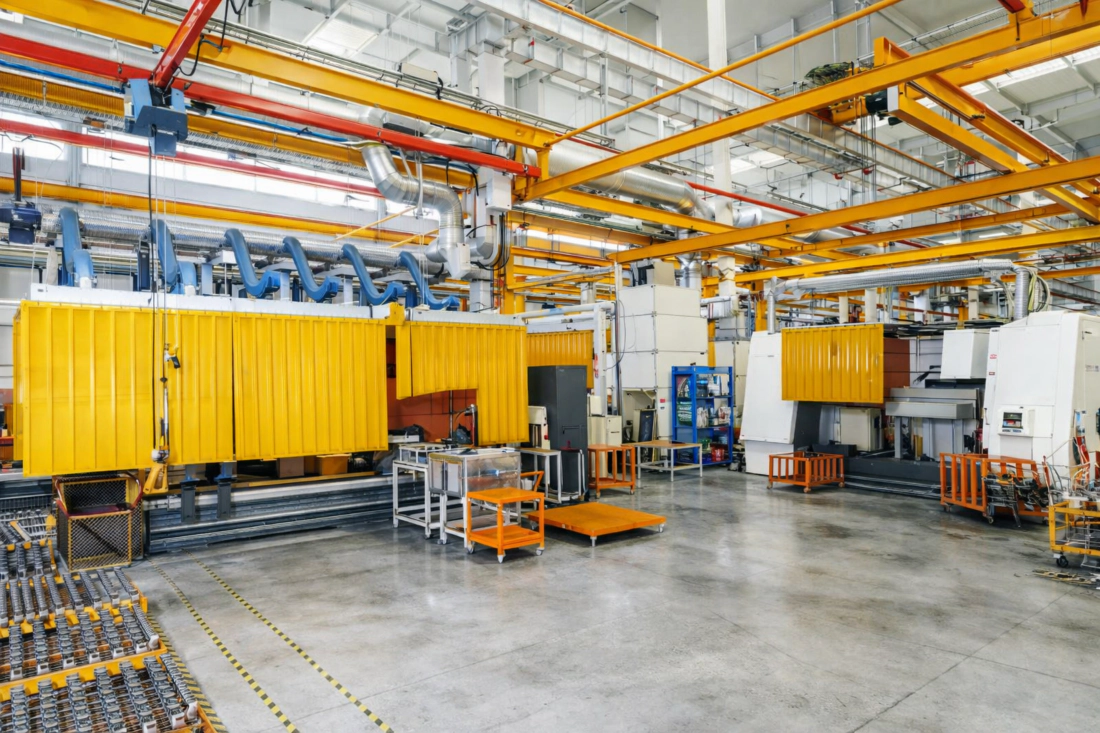
Tour Our Manufacturing Facility Virtually
We welcome orchard equipment designers, mulcher manufacturers, and agricultural machinery procurement teams to explore our production facility from anywhere in the world. View our welding stations, lug plate fabrication fixtures, powder coating line, and weld inspection equipment — all dedicated to producing cylinders that survive the impact and vibration loads of real agricultural field conditions.
Masuk ke Tur Pabrik VR
Inquire Now — Send Your Mulcher Cover Cylinder Requirements
How the Cover Opening Cylinder Works — and Why Mounting Integrity Is the Critical Factor
The double-acting piston cylinder lifting the orchard mulcher’s maintenance cover generates hydraulic force in both the lifting and lowering directions, giving the operator positive control over cover position throughout the opening and closing movement. The cover’s weight — typically 30 to 80 kilograms of formed steel plate with mounting hardware — requires sustained lifting force to raise to the maintenance-open position and positive hydraulic restoring force to close safely after maintenance is complete. A single-acting spring-return cylinder would lift adequately but depend on gravity and spring force for closing — a design that compromises operator safety when working around heavy covers that could close unexpectedly if hydraulic pressure is lost. The double-acting configuration maintains positive hydraulic holding force in the open position, keeping the cover stable while the operator accesses the cutting chamber, and provides controlled closing force that prevents the cover from slamming shut under its own weight when the operator commands it closed.
Welded cylinder construction is the fabrication approach that provides the structural integrity this application’s impact environment demands. An orchard mulcher cover cylinder is not subject to high operating pressure or rapid cycling — the cover opens and closes a few times per day at most, at the low to moderate pressures a cover lift requires. What it is subject to is continuous vibration and episodic shock loading transmitted through the machine structure during the hours of cutting operation that precede and follow each maintenance access event. Tie-rod cylinder construction — where the end caps are held against the barrel by external threaded rods — is vulnerable to tie-rod pre-load relaxation under this continuous vibration, allowing micro-motion at the end-cap face that progressively loosens the assembly and can lead to end-cap ejection under hydraulic pressure if loosening is not detected during maintenance inspections. Our welded construction integrates the end caps into the barrel as a monolithic structure, with weld joints that are not subject to the pre-load relaxation mechanism and that distribute structural loads across the full weld circumference rather than concentrating them in four discrete tie-rod locations.
The structural load path during mulcher impact events is the engineering reason that the lug plates — not the cylinder pressure components — are the primary failure location in orchard mulcher cover opening cylinders. When the cutting rotor strikes a stone or a large-diameter branch, the resulting impact force creates a transient acceleration that acts on every component of the machine structure, including the cover and the cylinder. The cylinder, connected at each end to machine frame and cover through its mounting lug plates, is effectively shaken by this acceleration. The force generated in the lug plates is proportional to the mass of the cylinder and cover multiplied by the peak acceleration of the impact event — a force that, for a 20 kg cylinder on a machine generating peak accelerations of 20 g or more during stone impact, can exceed 4,000 N instantaneously, applied in a direction that may be lateral to the cylinder axis rather than purely axial. A lug plate sized for the 1,000 to 2,000 N cover lifting load is severely understressed against this inertia loading, making the fatigue damage accumulation at the lug weld the inevitable consequence of standard lug dimensioning practices applied to an impact-intensive machine environment.
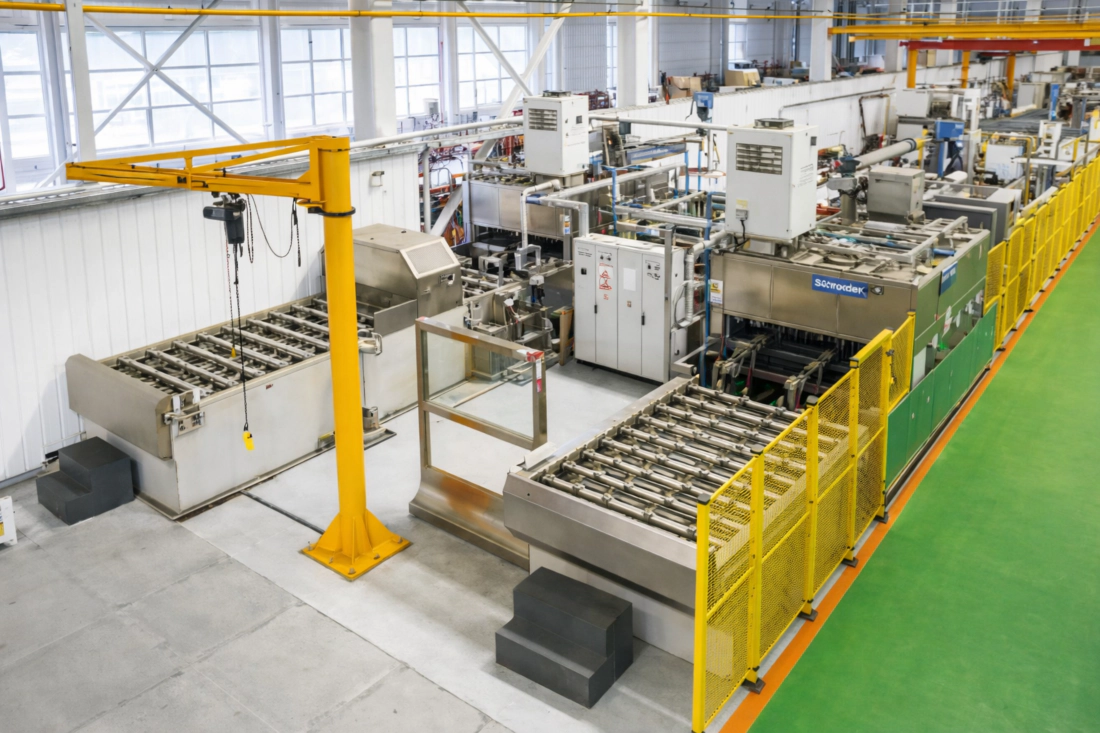
Technical Specifications — Orchard Mulcher Cover Opening Hydraulic Cylinders
The following parameters define our standard production range for Q345D welded hydraulic cylinders for orchard mulcher machine cover opening applications. All specifications are customizable through our engineering process. The lug plate dimensions, weld joint type, and powder coat color are determined from the customer’s machine frame design and cover weight data; the bore and stroke are derived from the required lifting force and cover opening geometry.
| Parameter | Spesifikasi | Engineering Notes |
|---|---|---|
| Action type | Double-acting piston | Positive holding force in open position; controlled close |
| Construction | Welded (full-penetration barrel and lug joints) | Eliminates tie-rod pre-load relaxation under vibration |
| Diameter lubang | 50 mm to 160 mm | Standard mulcher cover range: 63 to 100 mm |
| Diameter batang | 35 mm to 110 mm | Rod sized for combined lifting and lateral inertia load |
| Stroke range | 150 mm to 1,000 mm | Determined by cover hinge geometry and open angle |
| Operating pressure | Up to 20 MPa | Test pressure: 1.5x rated; 100% of production units |
| Cylinder material | Q345D low-alloy structural steel | Charpy impact energy at -20 degrees C: 34 J minimum |
| Yield strength | 345 MPa minimum (thickness up to 16 mm) | Tensile strength 470 to 630 MPa; good cold bending |
| Lug plate design | Thickened Q345D plate; full-penetration weld to barrel | Sized for inertia load, not cover weight alone |
| Weld inspection | MPI and UT on lug-to-barrel weld joints | Full penetration verified; root inspection documented |
| Perawatan permukaan | Thermosetting polyester powder coating | Thickness 60 to 100 µm; chip-resistant; UV stable |
| Rod surface | Hard chrome plating, 0.025 to 0.050 mm | Rod seal interface protection in outdoor storage |
| Rod seal | Polyurethane standard; NBR optional | Heavy-duty dust wiper seal standard for outdoor use |
| Suhu pengoperasian | -20 degrees C to +70 degrees C | Q345D D-grade toughness supports cold-start operation |
Q345D Material System — Strength, Toughness, and Weldability for Agricultural Impact Environments
Q345D low-alloy high-strength steel is the material specification that balances the three performance requirements of orchard mulcher cover opening cylinder construction: adequate yield and tensile strength for the cylinder’s pressure-containing and structural functions, sufficient impact toughness at low operating temperatures for reliable performance in cold-season orchard maintenance, and good weldability that allows the full-penetration lug plate joints to be made with confidence in joint quality across production batches. The designation Q345D in China’s GB/T 1591 standard specifies a minimum yield strength of 345 MPa, a tensile strength range of 470 to 630 MPa, and Charpy V-notch impact energy at -20 degrees Celsius of not less than 34 joules — the “D” in the designation specifically indicating this low-temperature impact requirement. For orchard equipment operating in northern China’s apple and pear growing regions — where Shaanxi, Gansu, and Shandong province orchards experience autumn morning temperatures at or below -10 degrees Celsius during the late harvest and early pruning seasons — this low-temperature toughness requirement is not a theoretical specification but a practical field condition that the cylinder material must meet to prevent brittle fracture events when the cold machine receives an impact load from a stone or frozen branch.
The impact toughness advantage of Q345D over the common Q235B mild steel frequently used in lower-specification agricultural cylinders is particularly relevant in the orchard mulcher application because the shock loading from stone and branch impacts creates high strain rate conditions in the cylinder structure — conditions where the distinction between a material’s static and dynamic toughness properties becomes practically important. At high strain rates, the effective yield strength of steel increases while the toughness decreases relative to quasi-static test values, and materials with limited toughness at low temperatures can transition from ductile to brittle behavior under these conditions even at temperatures above their static ductile-to-brittle transition temperature. Q345D’s guaranteed Charpy energy at -20 degrees Celsius provides confidence that the material remains in the ductile fracture regime under the strain rates associated with orchard mulcher stone impact events at field temperatures, rather than risking brittle fracture that could cause catastrophic structural failure of the cylinder mounting during mulching operation. The D-grade specification also implies tighter controls on sulfur and phosphorus content compared to B-grade Q345 — controlling the inclusion content that provides initiation sites for brittle fracture and fatigue crack growth in the material bulk and at weld heat-affected zones.
The weldability of Q345D — expressed through its carbon equivalent value of 0.45 percent maximum — allows the full-penetration lug plate joints that prevent fatigue cracking to be welded without the pre-heat and post-weld heat treatment procedures that would be required for higher-carbon steels used in some heavy machinery cylinder applications. This weldability characteristic is a practical production advantage that reduces the complexity and cycle time of lug plate welding operations, allowing the full-penetration joint quality to be achieved consistently in production quantities without the heat treatment infrastructure that more hardenable steels require. Our welding procedures for Q345D full-penetration lug joints are qualified per GB/T 19869 (or equivalent EN 288 for export-market products), using GMAW or SMAW processes with heat input parameters selected to achieve adequate fusion at the joint root without excessive heat input that would overheat the heat-affected zone and reduce toughness. The qualified welding procedure specification is available for customer review on request as part of the technical documentation package provided with each order.
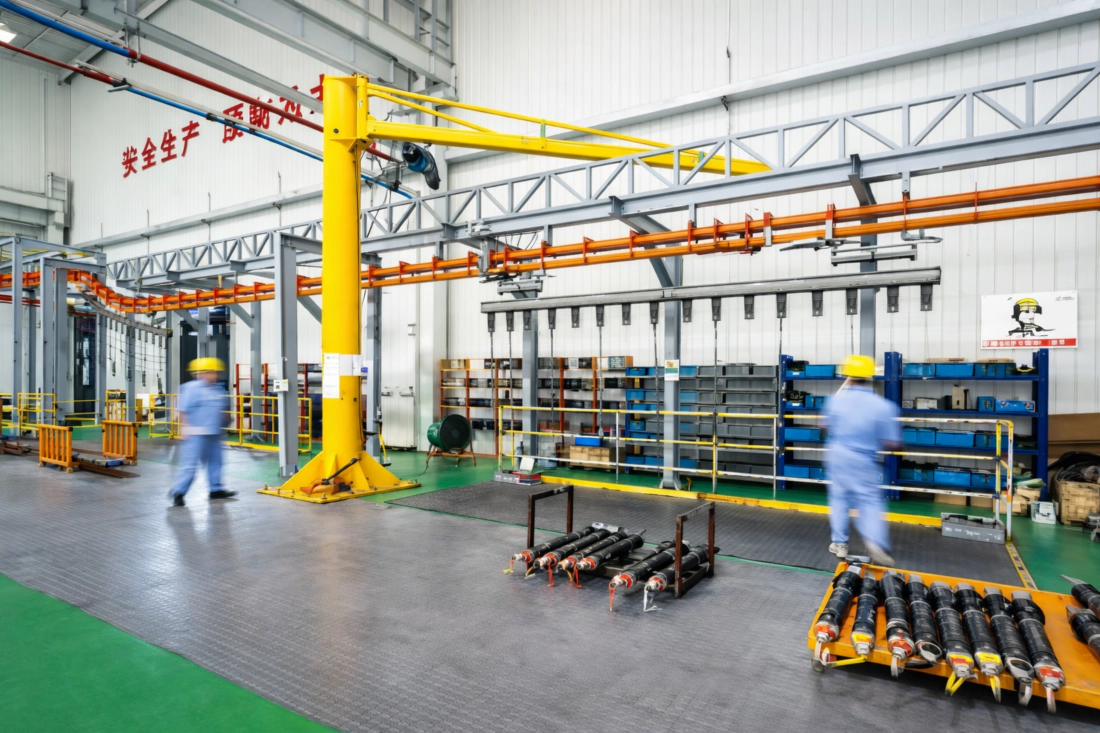
Powder Coating, Thickened Lug Plates, and Full-Penetration Welds — The Three-Layer Defense Against Field Failures
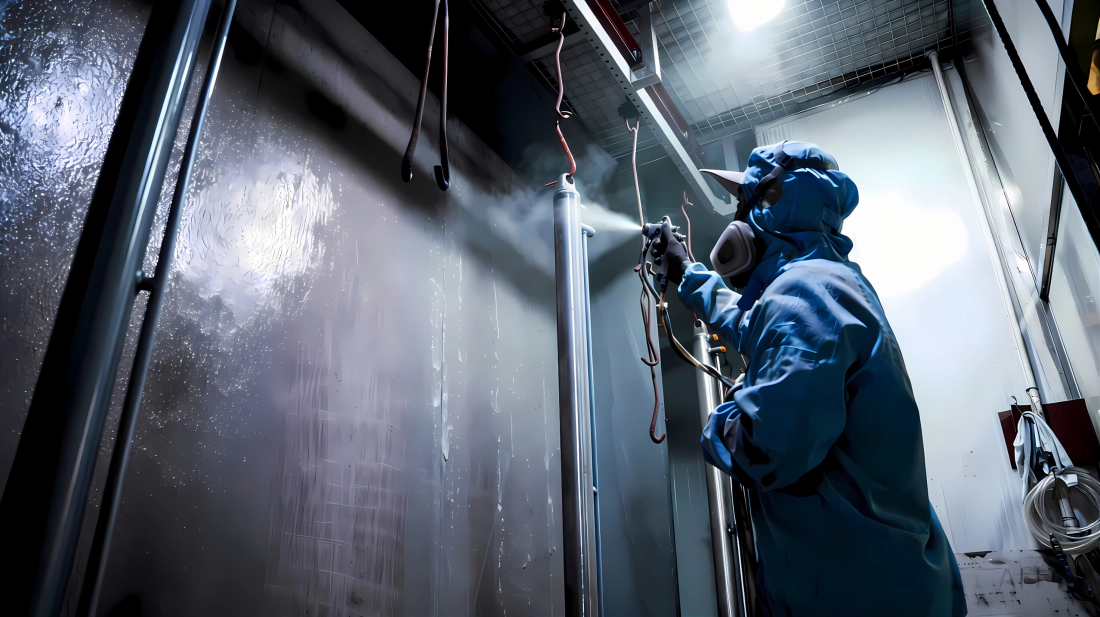
Thermosetting polyester powder coating applied to the external cylinder surfaces provides corrosion and abrasion protection that outperforms conventional liquid paint systems in the mechanical exposure environment of orchard mulcher operation. The orchard mulcher working environment is one where stone chips, woody branch fragments, and soil particles impact the machine surfaces continuously during cutting passes — a stream of abrasive projectiles that chips standard liquid paint from exposed areas within the first season of operation, leaving bare metal that progressively corrodes in the moisture and soil acid environment of the orchard floor. Powder coating achieves adhesion and film integrity that liquid paint cannot: the electrostatically applied powder melts and flows uniformly across the blast-cleaned substrate during oven cure at 180 to 200 degrees Celsius, creating a continuous film without the brush marks, drips, and thickness variations of liquid-applied paint, and bonding to the substrate with adhesion that is significantly greater than comparable liquid paint formulations. The resulting coating resists stone chip penetration at the film thickness of 60 to 100 micrometers that our standard application achieves, maintaining protective coverage of the cylinder surface across multiple working seasons without the annual repainting that liquid-paint-finished cylinders typically require in orchard mulcher service.
The thickened lug plate design addresses the ear lug cracking failure mode by increasing the cross-sectional area at the two most critical stress locations in the lug: the pin hole bore (where bearing stress from the clevis pin must be kept within the material’s bearing strength limit under peak inertia loading) and the weld attachment zone (where the lug plate connects to the cylinder barrel or end cap through the full-penetration weld joint). Standard lug plates dimensioned for cover lifting force alone typically provide pin hole bearing areas of 400 to 800 square millimeters and weld throat dimensions of 6 to 10 millimeters — adequate for quasi-static cover lifting at rated hydraulic pressure but insufficient for the peak inertia forces generated by stone impact events at the mass and acceleration levels typical of field-operating orchard mulchers. Our thickened lug plates for this application are dimensioned from an inertia load analysis using the cylinder and cover mass, the machine’s rated mulching capacity (which determines the cutting rotor speed and stone impact acceleration levels), and the lug geometry, producing plate thicknesses and pin hole dimensions that maintain bearing stress and weld throat stress below the fatigue strength limits of the Q345D material at 10 million loading cycles — the fatigue life target appropriate for a cylinder intended to survive multiple seasons of daily mulching operation.
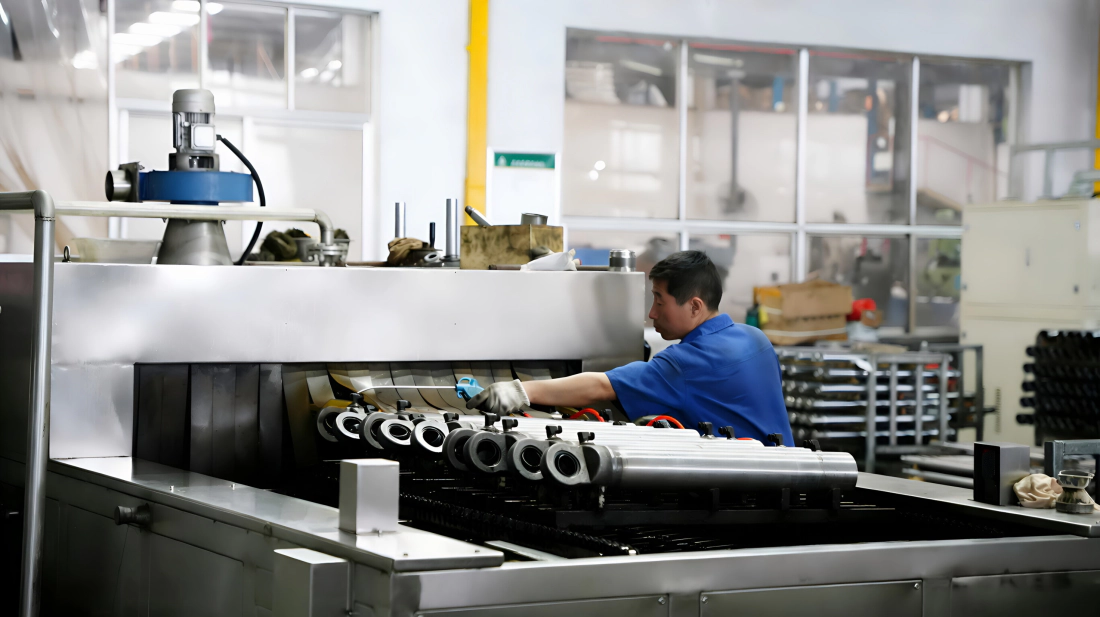
Full-penetration weld joints between the lug plates and the cylinder body eliminate the internal root notch that makes partial-penetration fillet welds inherently fatigue-limited in cyclic loading applications. A fillet weld joining a lug plate to a cylinder barrel produces a weld cross-section where the weld root — the innermost point of the weld, nearest to the unwelded portion of the joint — is a sharp geometric notch that concentrates stress from applied loads at a location that is difficult or impossible to inspect from the outside of the joint. Under repeated cyclic loading, fatigue cracks initiate at this root notch and propagate through the weld material or the heat-affected zone into the base metal, following the path of maximum stress concentration away from the notch. Full-penetration welding eliminates the root notch by fusing the weld metal completely through the joint thickness, leaving no unwelded internal surface. Our lug plate welding procedure achieves full penetration through joint preparation (V-groove or double-bevel preparation depending on plate thickness and access), proper welding parameters, and back-gouging of the root pass where access permits, followed by ultrasonic testing or magnetic particle inspection of the completed joint to verify that root fusion has been achieved across the full joint width. This inspection step distinguishes our production process from suppliers who specify full-penetration welds in documentation but verify only surface appearance rather than internal fusion quality.
Application Scenarios — Where Orchard Mulcher Cover Opening Cylinders Work Across Chinese and International Markets
Hydraulic cover opening cylinders for orchard mulchers appear in a wider range of machine types than the primary flail mulcher design suggests. Any orchard soil management machine with a heavy steel cover protecting the cutting mechanism from operator access during operation requires a cylinder that can safely lift and hold that cover for the duration of maintenance work, and can survive the impact and vibration loading that cutting operation generates while the cover is closed. The following deployment scenarios represent the primary applications across Chinese orchard regions and international export markets where our cover opening cylinders are most commonly specified.

Apple and Pear Orchard Flail Mulchers
Apple and pear orchards in Shaanxi, Gansu, Shandong, and Hebei provinces represent China’s largest commercial orchard areas and the primary domestic market for orchard mulcher equipment. Loess Plateau orchards in Shaanxi and Gansu are particularly stone-rich, with surface and near-surface rocks that enter the flail rotor regularly during standard mulching passes. Cover opening cylinders on Loess Plateau mulchers experience the most intense stone impact loading of any Chinese orchard environment — making thickened lug plates and full-penetration welds not optional enhancements but baseline requirements for reliable seasonal operation without mid-season cylinder replacement.
Citrus and Subtropical Orchard Mulchers
Citrus orchards in Guangdong, Fujian, Hunan, and Guangxi provinces operate mulchers in a higher-humidity environment where corrosion of unpainted or poorly coated cylinder surfaces is a faster process than in northern dryland orchard regions. Powder coating durability is particularly valuable in these subtropical environments, where condensation from temperature cycling and high rainfall accelerate corrosion at paint film discontinuities. The cover opening cylinder on subtropical citrus mulchers also encounters the dense, semi-woody stems of citrus prunings that create blade blockage events requiring more frequent cover opening for rotor clearing — increasing the operational cycle count on the cover cylinder compared to dryland apple orchard equivalents.
Vineyard and Grape Orchard Mulchers
Vineyard mulchers operating between vine rows in China’s Xinjiang, Ningxia, Hebei, and Yunnan wine-grape regions process dense, fibrous vine prunings that can accumulate around the rotor and require frequent clearing access through the machine cover. The cover opening cylinder on vineyard mulchers experiences higher lift cycle counts than most orchard mulcher applications — operators may open and close the cover multiple times per working day during heavy pruning season — making seal durability and rod surface quality important service life factors alongside the lug plate fatigue resistance that dominates in stone-heavy soil conditions. Vineyard mulchers in Xinjiang’s gravel-covered growing regions combine both the high lift cycle count and stone impact loading challenges.
Export-Market Mulcher Manufacturers
Chinese orchard mulcher manufacturers exporting to Italy, Spain, France, New Zealand, Australia, and Chile supply equipment to markets where orchard stone concentrations and operating intensities vary significantly from Chinese conditions. European export-market mulchers for Mediterranean olive and almond orchards encounter some of the highest stone concentrations in world orchard management — requiring cover opening cylinders with the same thickened lug and full-penetration weld specification as the most demanding Chinese apple orchard applications. Our cylinders are supplied to Chinese mulcher manufacturers as standard specification components for export product lines, with material certifications and welding procedure records that support the CE machinery directive documentation requirements of the export market.
Engineering Advantages That Distinguish Our Cover Opening Cylinders From Standard Agricultural Alternatives
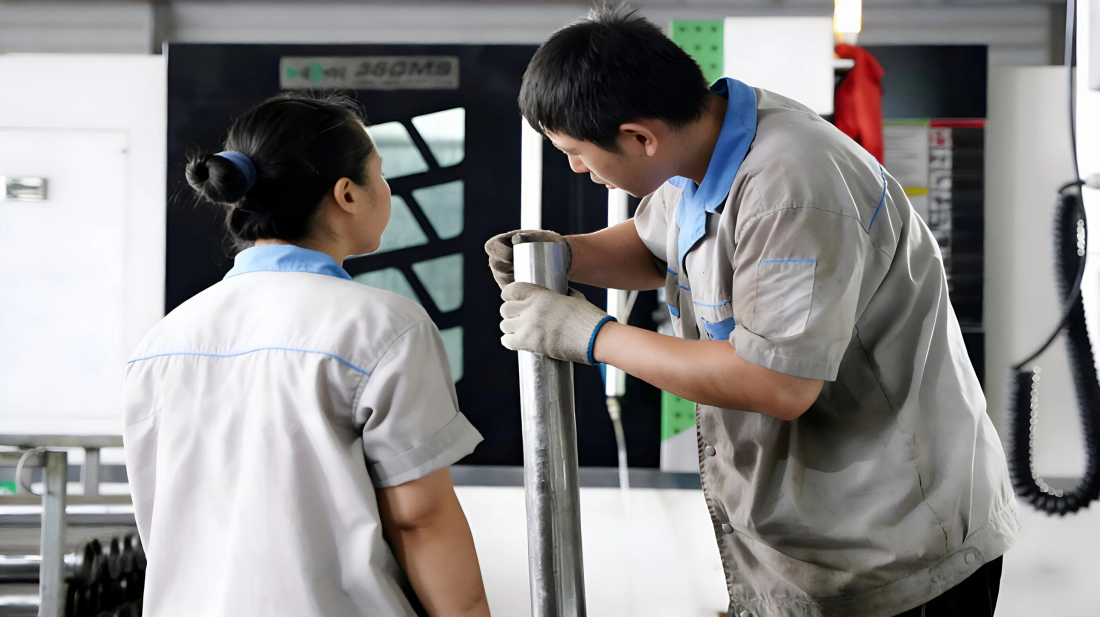
The service life difference between cover opening cylinders specified for the mulcher impact environment and standard agricultural cylinders adapted from catalog selections is most clearly visible in the lug failure statistics that orchard equipment dealers and service workshops accumulate across machine populations. Field maintenance records from orchard mulcher service networks in Shaanxi and Shandong provinces consistently identify cover cylinder lug plate cracking as the most frequent cover system repair requirement — typically occurring within 18 to 36 months on machines equipped with standard agricultural cylinders in stone-rich orchard soils. The cracking pattern follows the partial-penetration fillet weld toe at the lug-to-barrel interface: a single crack initiating at the weld root on one side of the lug, propagating through the weld throat and into the barrel wall, and eventually reaching a length where the lug visibly deflects under cover lifting load and the cylinder loses the ability to hold the cover securely in the open position. At this point, the cylinder must be replaced as an assembly rather than repaired — partial repairs to cracked structural welds in vibration-intensive environments are not reliable — and the replacement interval typically begins again with the same standard catalog cylinder selection.
Our cylinders with thickened Q345D lug plates and full-penetration weld joints have demonstrated field service intervals exceeding five years without lug cracking in equivalent stone-rich orchard mulcher environments — a lifecycle improvement that directly reduces the replacement cylinder cost per season for operators managing multiple machines and eliminates the operational disruption of an unplanned cover cylinder failure during the heavy mulching periods of spring and autumn orchard management programs. The powder coating’s chip resistance also contributes a secondary maintenance cost reduction: the cylinder exterior maintains protective coverage through multiple seasons without repainting, compared to liquid-painted alternatives that typically require at least an annual recoating touch-up on the stone-exposed areas of the machine to prevent progressive corrosion from bare metal zones around impact-stripped paint areas.
| Fitur | Our Cylinders | Standard Catalog Alternatives |
|---|---|---|
| Lug plate design | Thickened for inertia load; full-penetration weld | Sized for lifting load only; partial-penetration fillet weld |
| Material grade | Q345D — guaranteed impact toughness at -20 degrees C | Q235B — no low-temperature toughness guarantee |
| Perawatan permukaan | Thermosetting powder coat — chip-resistant, UV stable | Liquid paint — chips at stone impact, annual recoat needed |
| Weld inspection | MPI and UT — full penetration verified internally | Visual inspection only — root quality unverified |
| Construction | Full-penetration welded — no tie-rod pre-load risk | Tie-rod — pre-load relaxation under vibration |
| Typical lug service life | 5+ years without cracking in stone-rich orchards | 18 to 36 months before lug crack replacement |
Custom Manufacturing — From Your Mulcher Design Data to a Finished, Tested Cover Cylinder
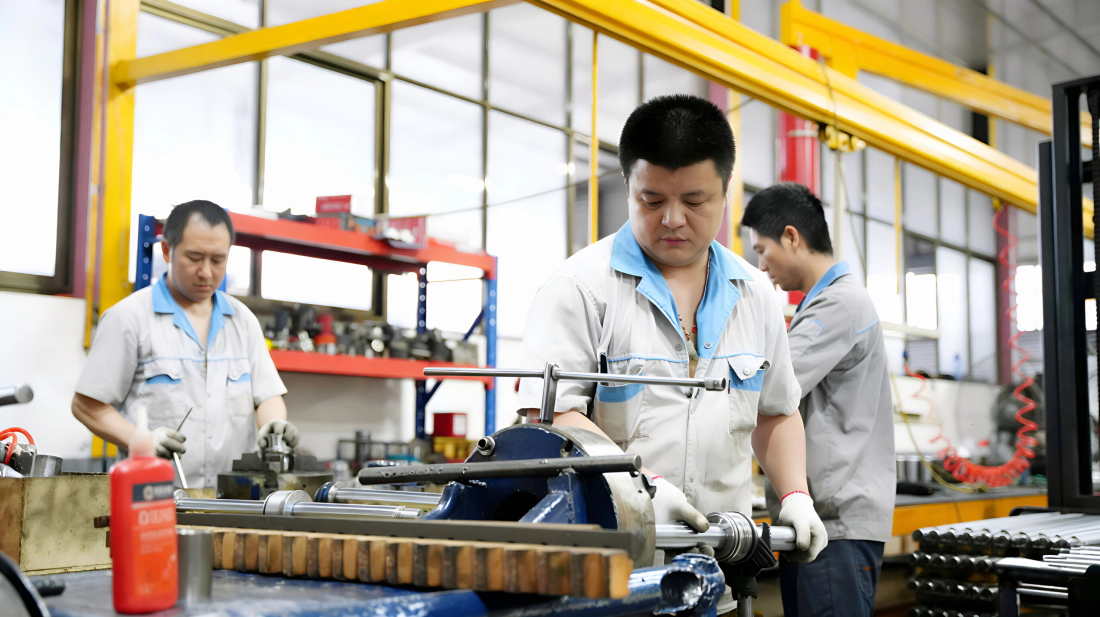
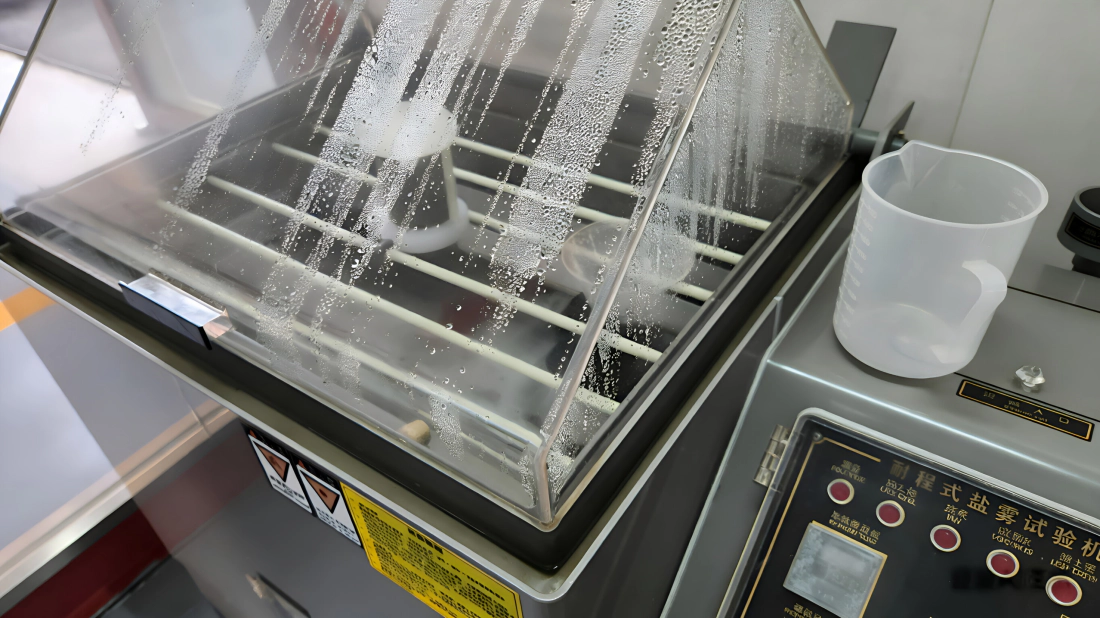
Our manufacturing facility in China produces Q345D welded cover opening cylinders across bore diameters from 50 to 160 mm, strokes from 150 to 1,000 mm, and lug plate configurations spanning clevis, flange, and trunnion mounting options in both standard and custom geometry. The welding qualification records and material certifications maintained for Q345D cylinder production cover the range of joint types and plate thicknesses used in cover opening cylinder lug plate construction — documents that support Chinese mulcher manufacturers’ product quality records and that export-market OEMs require for CE machinery directive technical files. Powder coating is applied at our in-house coating facility after shot blasting and zinc phosphate pretreatment, with color and gloss level selected to match the customer’s existing equipment color scheme — standard agricultural equipment colors including green, yellow, red, and orange are all available within the standard production process. Our weld inspection station performs magnetic particle inspection and ultrasonic examination of lug-to-barrel weld joints on every production cylinder, with results recorded and provided as inspection documentation with the shipment. More information about our engineering team and production quality systems is available at our About Us page.
Mulcher manufacturers at any stage of machine development — from concept layouts to production engineering — are welcome to engage our engineering team early. When cover geometry and cover weight are established but before the cylinder mounting points are fixed in the frame design, we can provide lug geometry recommendations that optimize the cylinder-to-frame connection for both lifting function and inertia load resistance, saving iteration cycles in the machine design process. Our inertia load analysis uses the machine’s rotor impact specification (typically expressed as rated stone capacity or maximum object dimension the rotor is designed to handle), the cylinder and cover assembly mass, and the mounting geometry to determine the lug plate thickness and pin hole dimensions that achieve the target fatigue safety factor at the design impact loading level. This analysis is provided as part of our standard quotation process for customers who supply the mulcher’s rated operating parameters alongside the cylinder dimensional requirements.
Prototype cylinders for new mulcher model development are available within 20 to 30 working days for most custom configurations. Serial production lead times of 30 to 45 working days accommodate standard mulcher manufacturing program schedules. We supply cylinders pre-painted in the customer’s standard machine color, with mounting hardware dimensions matched to the customer’s pin specification, and port thread standards matching the customer’s hydraulic circuit fittings — reducing the assembly fit-check work at the machine plant and allowing direct integration into the machine assembly sequence without component modification. For orchard equipment manufacturers supplying European markets, we provide material test certificates to EN 10025 equivalent standards for Q345D (approximately equivalent to S355J2) alongside the Chinese GB/T 1591 mill certificate, supporting the dual-standard documentation requirements of Chinese-manufactured machines entering CE-marked product programs.
Customer Success Stories — Cover Opening Cylinders in Orchard Mulcher Field Operation
Orchard Mulcher Manufacturer, Emilia-Romagna Region
An Italian manufacturer of tractor-mounted orchard mulchers supplying the Mediterranean olive, almond, and citrus growing regions was experiencing persistent warranty claims for cover cylinder lug cracking on machines deployed in stone-rich Sicilian and Apulian olive orchards. The stone concentration in these soils is among the highest of any commercial orchard environment in the world, and the standard catalog cylinders the manufacturer had been sourcing showed lug cracks within one to two seasons consistently. Our engineering team analyzed the impact loading from the manufacturer’s rotor specification, designed thickened Q345D lug plates sized for the calculated peak inertia force, and supplied first prototype units within 28 working days. After two full olive mulching seasons in the target orchard environment, no lug cracking was reported on any machine in the prototype evaluation batch. The manufacturer standardized our specification across their full product range for Mediterranean market models.
“Two Sicilian olive seasons, zero lug cracks. Our warranty department had been handling two or three cover cylinder claims per season per batch. This year — none. The inertia load analysis was the engineering step we had been missing.”
— Technical Director, Orchard Mulcher Manufacturer, Emilia-Romagna, Italy
Apple Orchard Management Company, Shaanxi Province
An apple orchard management company operating 14 flail mulchers across hillside Loess Plateau orchards in Shaanxi Province had been replacing cover opening cylinders every season on their three oldest machines — the ones operating in the most stone-rich areas of the orchard estate. The replacement cylinders being sourced locally showed the same lug cracking pattern within 12 to 18 months of installation. After switching to our Q345D cylinders with thickened lug plates and full-penetration welds on all 14 machines in the fleet, the company completed three consecutive mulching seasons without a single cover cylinder lug failure across the entire fleet — including the high-stone orchard areas that had been causing the annual failures. The company subsequently extended the seasonal maintenance inspection interval for the cover cylinder from every 200 operating hours to every 400 hours, based on the absence of lug cracking indications through the full three-year evaluation period.
“Three seasons, 14 machines, zero lug failures — including the areas that had been breaking cylinders annually. We extended our inspection interval because there was nothing to find. That is the result we had been trying to get for three years.”
— Equipment Manager, Apple Orchard Management Company, Shaanxi Province, China
Orchard Equipment Importer and Distributor, Canterbury Region
A New Zealand equipment importer and distributor supplying mulchers to Canterbury apple and cherry orchards and Hawke’s Bay mixed orchards was developing a private-label mulcher range sourced from China. Their design brief required CE machinery directive compliance for export to Australia, cover cylinder color matching their existing equipment range, and supply documentation supporting their importation quality records. Our engineering team supplied Q345D cylinders in their specified yellow powder coat color, with EN 10025 equivalent material certificates alongside the GB/T 1591 mill documentation, and welding procedure records in the format required for CE technical file assembly. The first shipment of 60 units was delivered within 38 working days, and the product launched into the New Zealand and Australian market on schedule without any compliance documentation gaps that could have delayed regulatory approval.
“Correct color, EN 10025 certs alongside Chinese mill docs, welding procedures ready for the CE technical file — 38 days, 60 units. The compliance documentation was complete enough that our certifier had no follow-up questions.”
— General Manager, Orchard Equipment Importer and Distributor, Canterbury, New Zealand
Pertanyaan yang Sering Diajukan
+What type of hydraulic cylinder is best suited for opening the maintenance cover on an orchard mulcher operating in rocky terrain with stone and branch impact in Chinese apple orchard environments?
A double-acting piston cylinder with welded Q345D construction, thickened lug plates, full-penetration weld joints at the lug-to-barrel interface, and thermosetting powder coat exterior finish is the specification that addresses the complete failure risk profile of orchard mulcher cover opening applications in stone-rich Chinese orchard environments. The double-acting design is essential for positive holding force in the open position and controlled closing — safety requirements in any cover cylinder application. The welded construction eliminates tie-rod pre-load relaxation under vibration. Q345D’s D-grade low-temperature toughness supports cold-morning operation in northern orchard regions where autumn maintenance happens at temperatures that approach the brittle-ductile transition of standard mild steel. The thickened lug plates and full-penetration welds specifically address the dominant failure mode — lug cracking under stone impact inertia loading — that terminates standard catalog cylinder service life in one to two seasons in stone-intensive Shaanxi and Shandong apple orchard mulcher applications.
+How much does a custom Q345D welded hydraulic cylinder for orchard mulcher cover opening typically cost from a Chinese manufacturer, and what factors most affect the quoted price?
Custom pricing for Q345D welded cover opening cylinders depends on bore diameter, stroke length, lug plate geometry and thickness, order quantity, and the documentation package required. Bore size is the primary pricing factor — the material and machining cost for bore diameters above 100 mm increases significantly. Thickened lug plate construction adds a modest premium over standard lug plates due to additional material and welding labor; full-penetration weld inspection (MPI and UT) adds a quality cost that is typically 5 to 10 percent of the cylinder unit price at production quantities. Powder coating adds surface preparation and coating cost that varies with the cylinder exterior surface area. At production volumes of 30 units or more, Chinese manufacturer pricing for Q345D cover cylinders with all the described features remains competitive compared to equivalent specifications from European or North American suppliers. Submitting your cover weight, hinge geometry, stroke requirement, and required color for a specific project quotation is the most accurate path to pricing information.
+Why do hydraulic cylinder mounting ear lugs crack on orchard mulcher cover opening cylinders, and how does thickening the lug plates combined with full-penetration welds prevent this failure mode?
Lug cracking on orchard mulcher cover cylinders is a fatigue failure driven by the inertia loads that stone and branch impacts create in the machine structure, not by the cover lifting load the cylinder is designed for. When the rotor strikes a stone, the resulting impact acceleration acts on the cylinder as a force proportional to the cylinder and cover mass multiplied by the impact acceleration — a force that can substantially exceed the cover lifting load in machines operating in stone-rich soils. This inertia force is transmitted to the lug plates at each end of the cylinder and applied to the weld joint attaching each lug to the cylinder body. A partial-penetration fillet weld at this joint has an internal notch at the weld root where stress concentrates under each loading cycle. Over thousands of impact events across a season, fatigue cracks initiate at this root notch and propagate through the weld. Thickened lug plates reduce the stress at the weld joint and pin hole by increasing the cross-section area. Full-penetration welds eliminate the internal root notch entirely, removing the initiation site for fatigue cracking. Together, these two design measures raise the lug joint’s fatigue life from one or two seasons to five or more years in equivalent orchard mulcher service.
+Which surface treatment performs better for hydraulic cylinders on orchard mulcher machines in stone and branch impact environments — powder coating or standard liquid paint — and what is the practical difference?
Thermosetting powder coating substantially outperforms liquid paint in orchard mulcher stone and branch impact environments, for reasons rooted in the film formation mechanism and adhesion chemistry of each type. Liquid paint is applied wet and forms its protective film by solvent evaporation, producing a coating with internal stress from the drying shrinkage process and adhesion that is lower than the powder coating equivalent. When a stone chip strikes a liquid-painted surface, the impact energy can shear the film from the substrate at the impact point and propagate a delamination zone around the initial chip — a failure pattern that is familiar to anyone who has examined the stone-chipped paint on agricultural equipment after a season of orchard mulcher field operation. Powder coating is applied as dry powder and cures by heat-induced fusion and cross-linking, creating a continuous film without internal drying stress and with adhesion from chemical bonding to the substrate pretreatment layer that resists the shear forces of stone impact significantly better. The practical outcome is that powder-coated mulcher cylinders typically require no recoating for two to three seasons, while liquid-painted equivalents need at minimum an annual touch-up of the impact-chipped areas to prevent progressive corrosion from bare metal zones.
+Where can I find a reliable hydraulic cylinder manufacturer in China that supplies custom Q345D welded cylinders with reinforced lug plates and full-penetration welds for orchard mulcher maintenance cover applications?
Chinese manufacturers capable of producing orchard mulcher cover cylinders with the full specification — Q345D with D-grade low-temperature impact certification, thickened lug plates sized from inertia load analysis, full-penetration weld joints verified by MPI and UT inspection, and thermosetting powder coat in custom colors — represent a specialized subset of the general hydraulic cylinder manufacturing sector. Key qualification indicators include: whether the supplier performs an inertia load analysis from machine operating parameters or simply accepts dimensional specifications; whether weld inspection records include internal fusion verification (UT or MPI) or only visual examination; and whether the powder coat process uses thermosetting polyester with blast pretreatment and primer, or a simpler paint system described as powder coating. Our facility in China exports Q345D mulcher cylinders to orchard equipment manufacturers and distributors in Italy, France, New Zealand, Australia, and across the Chinese domestic market, with material and weld documentation that supports CE machinery directive technical file assembly for export-market products. Lead times of 20 to 30 working days for prototypes and 30 to 45 working days for production batches apply to most configurations.
+When should the mounting ear lugs on an orchard mulcher cover opening cylinder be inspected for fatigue cracks, and what visible signs indicate that a lug is approaching failure before complete separation occurs?
For orchard mulchers equipped with standard catalog cover cylinders in stone-rich environments, lug inspection should be performed at every seasonal maintenance interval and after any unusual impact event where a large stone or buried object enters the rotor. With our Q345D cylinders with thickened lugs and full-penetration welds, the inspection interval can be extended to every two seasons or 400 operating hours based on field performance data, but periodic inspection remains advisable. Visual signs that a lug is developing fatigue damage before complete separation include: rust staining or moisture tracking at the weld toe on one or both sides of the lug plate — indicating that a crack has opened at the surface and is wicking moisture; a small but perceptible wobble of the cylinder at the mounting pin when force is applied transverse to the cylinder axis — indicating that the lug joint has partially separated; and paint cracking or bubbling at the weld toe junction — often the first visible indication that the base metal or weld heat-affected zone underneath has developed a surface crack. If any of these signs are observed, the cylinder should be removed from service and the lug weld inspected by magnetic particle testing before further operation — continuing to operate with a cracked lug risks sudden separation of the cover during maintenance, which is a safety hazard for the operator working in the cutting chamber.
Ready to Specify Your Orchard Mulcher Cover Cylinder?
Send us your machine’s cover weight, cover hinge geometry, required cylinder stroke, rated mulcher rotor capacity, and your target color specification. Our engineering team will perform an inertia load analysis, determine appropriate lug plate dimensions, and provide a complete cylinder specification proposal within three working days — at no cost. We serve orchard mulcher manufacturers and distributors across China, Italy, France, Spain, New Zealand, Australia, and more than 40 other international markets.
Full product range at hydrauliccylindersmanufacturer.com