Precision Control in High Winds: The Anti-Stutter Hook Swing Cylinder
If you have ever tried to position a glass panel on a façade in Rotterdam while the wind is gusting at force 5, you know the nightmare of “hook jitter.” You tap the joystick just a millimeter to correct the swing, and the hydraulic cylinder controlling the jib tip or the hook angle doesn’t move… doesn’t move… and then—bang—it jumps two inches. That is the dreaded “stick-slip” phenomenon. In my 18 years of analyzing hydraulic failures, this is the number one complaint I hear from precision crane operators.
Most people think the main boom cylinder is the star of the show. But for the guy in the cab, the Hook Swing/Jib Luffing Cylinder is the one that determines if he goes home stressed or satisfied. These cylinders operate in a brutal range: high frequency, small amplitude. You aren’t doing full strokes; you are doing thousands of micro-adjustments per hour to fight the swing. Standard cylinders with standard rubber seals just burn out in this environment. They can’t build up the lubrication film on the rod, leading to heat, friction, and eventually, that dangerous stutter.
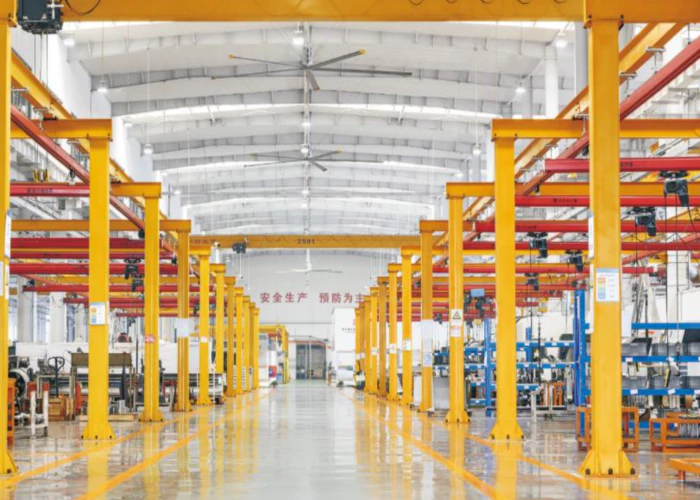
We realized about a decade ago that using heavy off-the-shelf cylinders for this was a mistake. You need something lighter, faster, and slipperier. That is why we switched to Acier allié 27SiMn and low-friction PTFE sealing systems. But you don’t have to take my word for it (I’m just an engineer who loves steel, after all). Why not walk through our shop floor yourself?
👓 See The Precision Manufacturing
Check out the honing machines we use to get that mirror finish on the cylinder barrels. It’s fully immersive.
>> Cliquez ici pour visiter notre usine de réalité virtuelle
The Physics of the “Micro-Move”
Here is the technical challenge that most generic suppliers miss. When a cylinder moves less than 50mm back and forth (which happens constantly when you are stabilizing a swinging hook), the oil film on the rod never gets a chance to fully establish. In a standard ST52 cylinder with NBR (Nitrile) seals, this results in direct contact between the seal lip and the chrome. Friction spikes. Heat builds up. The seal literally melts or wears a groove into the rod.
In our experience, especially with the Dutch climate, where it’s damp and cold, this stick-slip issue is amplified. The trick is to lower the breakout friction. We utilize a Conception à piston à double effet with specialized Teflon-Bronze composite seals (PTFE). These materials have a friction coefficient similar to ice-on-ice. Even if the pressure is high, the seal glides.
Furthermore, we use Acier 27SiMn (silicium-manganèse) for the barrel and rod. This material is lighter and has higher tensile strength than standard carbon steel. On a fly jib or a hook block, every kilogram of weight you save is an extra kilogram of lifting capacity for the customer. It reduces the pendulum effect of the boom tip itself.

Technical Architecture: Built for Finesse
We don’t just build these to “push”; we build them to “position.” The tolerances are tighter than your average outrigger cylinder because there is no room for deadband.
| Paramètre | High-Frequency Series Spec | Pourquoi c'est important |
|---|---|---|
| Structure | Piston soudé à double effet | Compact design allows for tight integration into jib tips. |
| Matériel | Acier allié 27SiMn | High strength-to-weight ratio; reduces boom tip mass. |
| Technologie d'étanchéité | Low-Friction PTFE (Step Seals) | Eliminates “stick-slip” for smooth, precise micro-movements. |
| Revêtement de tige | Multi-layer Hard Chrome (>40μm) | Resists corrosion in Dutch maritime/port environments. |
| Pression de travail | 210 Bar – 250 Bar | Optimized for standard crane hydraulic circuits. |
| Stroke Type | Short Stroke / High Frequency | Designed specifically for constant adjustment without overheating. |
🇳🇱 Case Study: Precision Glazing in Amsterdam
Le client : “Randstad Geveltechniek B.V.” (Name changed for privacy), a specialist in high-rise facade installation operating in the narrow, windy streets of Amsterdam.
Le défi : They were using a spider crane with a hydraulic fly jib to install 300kg glass panes. The original cylinder on the jib luffing (which controls the hook distance) was jerky. In the “canyons” between buildings, wind swirls are unpredictable. The operator couldn’t dampen the swing effectively because the cylinder had a 2-second delay and then a sudden jump. They broke two panes in one month due to impact.
La solution : We replaced the standard unit with our Low-Friction 27SiMn Swing Cylinder. We customized the port sizes to increase flow sensitivity and used a Parker-equivalent low-friction seal kit.
Le résultat : The operator described the difference as “night and day.” The movement became fluid. They could nudge the hook 5mm at a time without the jump. Installation time per pane dropped by 15% because they weren’t waiting for the load to settle.
Feedback from the Dutch Market
★★★★★
“The lighter weight of the 27SiMn cylinder actually helped our load chart on the jib. It’s a small detail, but at 30 meters outreach, every kilo counts.”
— Jan de V., Technical Manager, Utrecht
★★★★★
“We perform maintenance in the Port of Rotterdam. Salt spray eats everything. These cylinders have been running for 2 years, and the rod chrome is still perfect.”
— Willem K., Crane Service, Rotterdam
★★★★★
“The response time on the custom design was fast. We had a broken Liebherr part, and Ever Power made a better version in 3 weeks.”
— Emma B., Procurement, Eindhoven
Où se place ce cylindre ?
While we focused on the hook swing/jib luffing, this specific “High Frequency, Low Friction” technology is a problem solver for several other applications found in the Netherlands.

- Robotic Manipulators: Construction robots used for bricklaying or demolition need hydraulic muscle but electric-like precision. Our low-friction seals are perfect for this “haptic” feedback.
- Hydraulic Grabs & Clamshells: These attachments open and close thousands of times a day. The “High Frequency” durability of our welded design prevents the fatigue cracks often seen in cast cylinders.
- Steering Cylinders: For multi-axle trailers (SPMTs) used in Dutch heavy transport. Precision steering requires the same “no-stick” characteristic to prevent the trailer from wandering.
Personnalisation : Nous réinventons pour répondre à vos besoins.
Let’s be honest, buying OEM parts for a 15-year-old crane is a headache. Half the time, the part number is obsolete. We take a different approach. We are a custom manufacturing house.
You tell us: “I need it to fit these pin dimensions, but I need it to move more smoothly.” We take that input. We might adjust the clearance between the piston and the barrel to optimize the oil film. We might add a specific wiper seal to handle the sand if you are working on the coast. We engineer the cylinder to the application, not just the catalog.
Analyse stratégique des produits (SWOT)
Transparency is key. Here is how our Low-Friction Swing Cylinder stacks up against the market.
💪 Points forts
- Précision: Low-friction seals enable millimeter-perfect hook placement.
- Poids: The 27SiMn alloy reduces dead weight on the boom tip.
- Durabilité: Designed for high-frequency cycling without overheating.
🔻 Faiblesses
- Coût: PTFE seals and alloy steel are more expensive than standard rubber/carbon steel.
- Entretien: Requires clean oil; low-friction seals are sensitive to contamination.
🚀 Opportunités
- Safety Regs: Stricter EU lifting norms demand better load control.
- Wind Energy: Offshore maintenance requires high-stability equipment.
⚠️ Menaces
- Actionneurs électriques : Small electric rams are competing in the very light-load sector.
- Counterfeits: Poor quality copies that look the same but lack the seal tech.
Chatting About Hydraulics: Your Questions
Why does my crane hook jump when I try to move it slowly?
That is the classic “stick-slip” effect. The static friction of your cylinder seals is too high. When pressure builds, it breaks free suddenly rather than sliding. You need a cylinder with joints en PTFE à faible friction to get smooth, continuous movement.
How quickly can you ship a custom cylinder to the Netherlands?
We ship to the Netherlands regularly. For custom jobs, once the drawing is approved, production takes about 3-4 weeks. Air freight to Schiphol (AMS) or sea freight to Rotterdam can be arranged depending on how urgent your repair is.
Is 27SiMn steel really better than standard ST52?
Yes, significantly. 27SiMn has a higher yield strength, which allows us to use thinner cylinder walls without risking ballooning. This reduces the weight of the cylinder itself, which is critical when it’s mounted at the very tip of a long crane boom.
What is the price of a replacement jib luffing cylinder?
It depends on the size and the seal kit required. However, our direct manufacturing price is usually 25% lower than the OEM markup. If you click “Inquire Now,” we can give you an exact quote within 24 hours.
Do these cylinders come with a warranty?
Absolutely. We offer a 12-month warranty on materials and workmanship. Because we pressure test every single unit before it leaves the factory, we are confident it won’t leak when you install it.
Stop the Swing, Start the Precision
Upgrade your crane with cylinders designed for Dutch precision. Lightweight, smooth, and reliable.
Direct Factory Pricing • Fast Shipping to Rotterdam