The Symmetry Advantage: Double-Rod Hydraulic Cylinders Explained
Why engineers choose the “Through-Rod” for precision, balance, and unwavering control.
You know that feeling when you’re tuning a hydraulic system, and you just can’t get the retraction speed to match the extension speed without adding a mess of flow control valves? I’ve been there, standing on a greasy shop floor, scratching my head while the PLC programmer gives me the “hurry up” look. That is usually the moment I wish the original designer had specified a Double-Rod Hydraulic Cylinder. In the 18+ years I’ve been designing fluid power systems, I’ve found that while standard differential cylinders are great for brute force lifting (like a dump truck), they are terrible for precision horizontal motion. The Double-Rod (often called a “Through-Rod” or “Non-Differential” cylinder) is the unsung hero of the automation world. It solves the physics problem of unequal areas by simply having a piston rod extending from both ends of the barrel. It sounds simple, but the implications for control logic are massive.
When we talk about this specific design, we aren’t just talking about aesthetics. The magic lies in the “Annulus Area.” In a standard cylinder, one side of the piston is a full circle (piston area), and the other side is a donut shape (piston area minus rod area). This physics imbalance means that with the same flow rate, the cylinder moves faster retracting than extending. Most printers and junior engineers don’t realize how much heat and turbulence this generates in high-cycle applications. With a Double-Rod Cylinder, you have a donut shape on both sides. The effective area is identical. This means if you pump 10 GPM into either port, the actuator moves at the same velocity. For applications like power steering or synchronized testing rigs, this natural symmetry eliminates the need for expensive servo valves to artificially balance the motion. It is mechanically honest engineering.
The Engineering Core: Specs That Matter
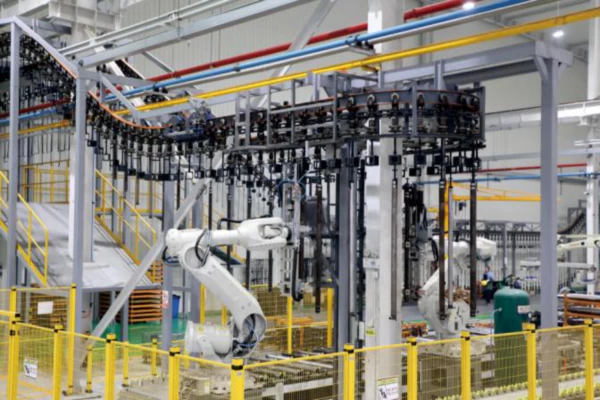
Our dedicated clean-room assembly for precision servo and double-rod actuators.
Manufacturing these units is a bit more demanding than your standard agricultural tie-rod cylinder. Why? Concentricity. When you have a rod exiting both ends, the two gland seals and the piston must be perfectly aligned on the same centerline. If the barrel bore is even slightly off-axis, or if the rod bows by a fraction of a millimeter, you get binding. We’ve seen cheap imported units where the rod literally gets stuck halfway through the stroke because the machining tolerances weren’t tight enough. We hold our concentricity to within 0.02mm TIR (Total Indicator Reading). This is why these cylinders are preferred for semiconductor equipment و robotics—they provide a rigid, guided linear motion that actually helps support the load, rather than just pushing it.
| ویژگی | مشخصات استاندارد | بینش «حرفهای قدیمی» |
|---|---|---|
| Symmetry | 1:1 Force & Speed Ratio | Makes PID loop tuning incredibly easy. No gain scheduling required for different directions. |
| جنس میله | CK45 / Stainless / Ceramic Coated | Since one rod end is often exposed to the back of the machine, protection is key. |
| آب بندی | Double Gland System (Low Friction) | Watch out for drag! Two rod seals mean double the friction. We use Teflon (PTFE) to mitigate this. |
| بازخورد موقعیت | External Linear Scale / Proximity | The “back” rod is the perfect place to mount limit switches or cams without interfering with the work. |
| حداکثر سرعت | Up to 2.5 m/s (Cushioned) | Always spec cushions on both ends. Double rods carry more momentum. |
SWOT Analysis: Is Double-Rod Right for Your Rig?
Before you commit to the design, you need to weigh the pros and cons. I love these cylinders, but they aren’t for every application. Space is usually the deal-breaker. Here is the strategic breakdown we use when consulting with OEMs.
نقاط قوت
- Control: Identical dynamics in extension and retraction.
- پایداری: The rod acts as a stabilizer, reducing side-load wear on piston seals.
- تطبیق پذیری: The second rod end can be used for manual overrides or sensor targets.
نقاط ضعف
- Footprint: The biggest drawback. You need space for the rod to extend on both sides.
- Force: Slightly less force than a standard cylinder of the same bore (no full piston area).
- هزینه: More machining, more seals, more material.
فرصتها
- Smart Steering: Ideal for rear-axle steering systems in heavy trucks where balance is critical.
- Hollow Rods: Perfect for running wiring or air lines through the center for robotics.
تهدیدها
- Electric Linear Motors: High-end electrics offer similar symmetry and are getting cheaper.
- همترازی: Poor installation alignment kills these cylinders faster than standard ones.
Where We See Them Shine (And Where We Don’t)

The classic application is Steering Cylinders. If you look under a heavy forklift or an articulated dump truck, you’ll often see a double-rod cylinder acting as the tie-rod. Why? Because you want the vehicle to turn left just as fast as it turns right. We also see massive adoption in Material Testing Rigs. When you are fatigue testing an aircraft wing component, you need to apply a sinusoidal load wave—push, pull, push, pull. If the cylinder has different forces in each direction, the waveform gets distorted, and your test data is garbage. The double-rod ensures the “push” and “pull” parts of the wave are mathematically identical.
Trend Analysis: The Hollow Advantage
Here is a trend that is picking up speed: Hollow-Rod Double Cylinders. In the semiconductor industry, space is at a premium. Engineers are asking us to gun-drill the entire length of the rod. This allows them to pass vacuum lines, sensor cables, or even coolant fluids right through the center of the actuator. It turns the hydraulic cylinder into a multi-functional conduit. It’s tricky to manufacture (sealing a moving tube is an art form), but we are doing it more and more for clean-room applications.
Case Study: The Wafer Polishing Solution
مشتری: NanoPrecision Tech (Semiconductor Sector) | مکان: Hsinchu, Taiwan
چالش: The client builds CMP (Chemical Mechanical Planarization) machines used to polish silicon wafers. They were using a standard differential cylinder to move the polishing head back and forth. The problem? The “pull” stroke was slightly faster and had less force than the “push” stroke, causing an uneven material removal rate (MRR) across the wafer surface. This inconsistency was leading to a 4% reject rate—which in the chip world, is millions of dollars.
راه حل ما: We replaced the actuator with a custom Precision Double-Rod Cylinder.
1. **Balance:** We achieved a 1:1 area ratio, ensuring the polishing pressure was identical in both scan directions.
2. **Cleanliness:** We used a special “Double-Lip” wiper seal made of food-grade PU to prevent any hydraulic micro-mist from escaping into the clean room.
3. **Mounting:** We designed a trunnion mount that utilized the double rod structure to stabilize the heavy polishing head, removing the need for external linear rails.
نتیجه: The reject rate dropped to 0.5% within the first month. The motion profile became perfectly symmetrical without complex software compensation.
“The symmetry of the double-rod design solved a control problem we’ve been fighting for two years. Simple physics beats complex coding every time.”
— Dr. Chen, Lead Mechanical Engineer
“Ever Power’s ability to customize the rod ends to fit our existing head mount saved us from redesigning the whole machine.”
— Wei-Ling, Procurement Manager
“Delivery was crucial. We needed a prototype in Taiwan in 3 weeks. They hit the deadline.”
— Jason T., Project Director
Factory Direct: We Build What Others Won’t
Let’s be honest, double-rod cylinders are a niche. Most big catalog suppliers only stock a few standard sizes, and if you need a different thread pitch or a specific stroke length, they tell you “16 weeks lead time.” We don’t play that game. We treat double-rod units as a core product, not an anomaly. We can customize the rod extension lengths independently (maybe you need a long rod on the front and a short stub on the back for a sensor?). We can machine the barrel from stainless steel, aluminum, or standard ST52, depending on your weight and corrosion requirements. We pressure test both gland seals simultaneously to ensure the unit is bulletproof.
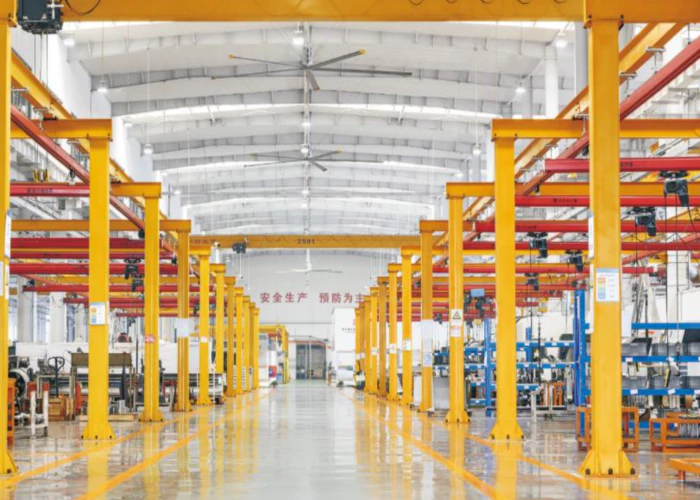
Step Inside Our Factory (Virtually)
We believe in transparency. See how we machine these double-rod units to 0.02mm tolerances right from your desk.
👉 برای بازدید از کارخانه واقعیت مجازی ما اینجا کلیک کنید
No passport needed. Just engineering excellence.
FAQ: Answering Your Technical Questions
How does a double-rod cylinder improve steering precision for autonomous vehicles?
It is all about volumetric balance. Because the rod volume exists on both sides of the piston, the oil volume required to move left is exactly the same as moving right. This means your steering controller doesn’t need complex algorithms to compensate for different speeds; the physical feedback is identical in both directions.
What is the typical price for a custom stainless steel double-rod cylinder in the UK market?
Stainless units for marine or food environments usually carry a premium. For a standard 50mm bore, you might be looking at £600 to £1,200 depending on the stroke length. The dual sealing system adds a bit to the cost compared to standard units, but the longevity in corrosive environments is worth it.
Can you manufacture double-rod cylinders with hollow rods for running sensor cables through?
Yes, we do this frequently for semiconductor applications. We gun-drill the center of the rod so you can pass pneumatic lines or electrical wiring through the cylinder itself. It keeps the workspace clean and protects your sensitive cabling from getting snagged.
Where can I find a supplier who ships double-rod hydraulic cylinders to Singapore quickly?
We ship to Singapore and the wider Southeast Asian region weekly. For urgent breakdowns, we can air freight custom replacement units within 7-10 days. We understand that in high-tech manufacturing, downtime costs thousands per hour.
Why is my double-rod cylinder vibrating during the extension stroke?
Alignment is the usual suspect here. Because the rod is supported at two points externally, if your mounting surfaces aren’t perfectly parallel, the cylinder binds. We also check for ‘stick-slip’ in the seals; sometimes switching to a low-friction PTFE seal profile solves the jitter instantly.
Need Perfect Balance in Your Hydraulic System?
Stop compromising with differential cylinders. Let’s engineer a symmetrical solution.